Interpretation rules
The Australian Maritime Safety Authority (AMSA) supplies anonymous hourly-thinned public position reports. The project label ARA refers to regional area-and-time vessel exports; Global Fishing Watch (GFW) supplies gridded hourly presence. A closest point of approach (CPA) requires a defensible track, not one selected row. A power spectral density (PSD) reports mean-square pressure per hertz.
- Source level (SL) is the JOMOPANS-ECHO model output for a stated ship type, length, speed and frequency. Transmission loss (TL) is the RAM path loss for a stated frequency, environment, source depth, bearing and range. RLi = SL − TL is the resulting one-ship received-level estimate under those conditions. None is measured ambient SPL.
- Unrelated ships are summed in linear power.
- T0 is counts-relative analysis. T1 is nominal pressure from a pinned date-valid full response, not traceable T2 calibration. A scalar-anchored provisional level uses the exact-date WID2 10 Hz scalar, with a pooled magnitude-shape correction or stated bias; it is neither T1 nor phase corrected.
- Public AMSA CRAFT_ID is neither MMSI nor IMO and is not assumed stable across months.
- Exact direct RAM is the path reference. Interpolated and analytic-law products are screening tools only inside their tested scope.
- Every measured result remains below ship-specific attribution unless repeated directional consistency from a complete triplet is also established.
Station and case matrix
| Station / case | Waveform data | AIS context | Source model | TL coverage | Waveform analysis | Direction / calibration |
|---|---|---|---|---|---|---|
| H01W Feb 2026 | 672 nominal triplet-hours; 670 raw-count complete; 669 response-safe; 665 observed-only in directional inventory | AMSA monthly, Juan 678-row subset, GFW screening | JOMOPANS-ECHO where type, length and speed support it | 678 exact direct paths at 63/80 Hz; selected P1/P3/P4 at 25/40/63/80/100 Hz; all-source 63 Hz screen | Band energy, PSD, spectrogram, tonal, association, recurrence | Complete triplet; many methods run, gates mostly failed; T0/T1 |
| H01W Jul 10–12 | 129,599,997 observed counts; one final 0.004 s sample missing per node; 47/48 complete triplet hours; final hour withheld | AMSA aggregate 63 Hz predictor; 47/48 predictor hours; no exact-anchor hour | Corrected JOMOPANS-ECHO aggregate screen | Same-month 63 Hz H01W1 screen, fixed 6 m; no exact RAM anchor in the selected interval | Frozen aggregate transfer, post-result spectral atlas, frozen two-cluster source-arrival localization | Complete triplet for 47 hours; T1 nominal; aggregate transfer failed |
| H01W Aug 11–13 | 48 nominal; 47 complete; 46 response-safe/observed-only | ARA snapshots and broad context | Selected screens only | No production all-event exact campaign | Acoustics-first discovery, spectra, morphology | Complete triplet; exposed development; T0/T1 |
| H08S Aug 11–13 | 48 nominal; 47 complete; 46 response-safe/observed-only | Named ARA anchors and GFW sectors | Case dependent | Screening/context, no promoted wide campaign | Exact-80 derivative, spectral/tonal development | Complete triplet; direction methods and smell test; T1 |
| H10N Mar 31–Apr 2 | 48 nominal; 47 complete/response-safe/observed-only | Named ARA regional rows; GFW context | Named-case inputs where available | Selected screening and case products | DIMIJOHN, MAERSK, MSC MARINA event/morphology | Complete triplet; official target-window theoretical response establishes T1, not T2 |
| H10S Mar 31 | Event-scale H10S2/S3; H10S1 absent | Named exact rows selected from multi-vessel ARA regional exports | JOMOPANS-ECHO one-ship RL context | Exact direct 63 Hz cases; CRETANSEA 13:46 at 63/80 and 15:51/16:43 at 80/100; 3–12 m bank and smoothing audit | Band energy, nominal-pressure PSD, morphology, source-class context | No triplet direction; official target-window theoretical response establishes T1, not H10S1 health or T2 |
| H03 Aug | Exact 11–13 Aug holdings: H03N1/N2 present, H03N3 authoritative no-data; H03S1/S2/S3 complete | Bounded GFW/ARA context | Screening only | No promoted exact campaign | Counts-relative exploration; preserved scalar-family provisional bands; completed official-response T1 bands at 12.5–100 Hz | The five-node T1 derivative replays 2,400 values. Official minus scalar-family levels span +0.0526 to +0.6310 dB; seven tiny 100 Hz sign audits change, no lower-band signs. No T2, health or measured-delay claim. |
| H10S Aug 11–13 | H10S2/S3 canonical usable-but-gapped; each lacks only the first and last 0.002 s sample. H10S1 authoritative no-data. | Retained August ARA/GFW context | Not yet joined to a promoted case | No promoted exact campaign | No acoustic outcome opened from these new holdings | Two-node side only; exact-cache-ineligible boundary gaps; official H10 response is T1-capable but no derivative has run. |
| Multi-site Aug 13–14 remainder | Current: H01W1–3 exact; H03N1–2/H03S1–3, H08S1–3 and H10N1–2 usable-but-gapped; H03N3 and H10S1 no-data; H10N3 link-ready; H10S2 sent once and awaiting response; H10S3 planned next | Overlaps retained 13 August ARA capture periods | Not yet joined | No new TL product | No acoustic outcome opened; holdings are inventory only | At most two localized samples missing per accepted gapped stream; no repair, exact-cache use or silent uninterrupted timing analysis. |
Response and provisional nominal-pressure policy
Every retained CM6 waveform record carries WID2 CALIB and CALPER. In the holdings used here, CALPER=0.1 s, so the scalar anchors nominal pressure at 10 Hz. As a concrete check, H08S1 reports 542 µPa/count in WID2 while its date-valid full response evaluates to 541.962710 µPa/count at 10 Hz, a 0.007% difference.
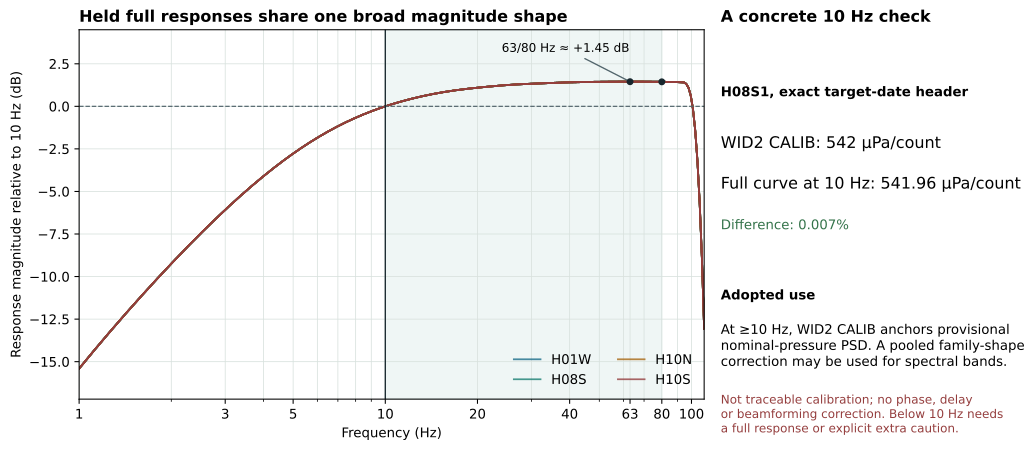
| Frequency | Pooled magnitude relative to 10 Hz | Use |
|---|---|---|
| 1 Hz | −15.41 dB | Outside the scalar policy; do not extrapolate. |
| 5 Hz | −2.78 dB | Below the adopted boundary; explicit response required. |
| 10 Hz | 0 dB | WID2 scalar anchor. |
| 20 / 40 Hz | +1.10 / +1.41 dB | Pooled magnitude-only family correction permitted. |
| 63 / 80 Hz | +1.447 / +1.439 dB | Central provisional screening bands; scalar-only results carry about 1–1.5 dB response-shape bias. |
| 100 Hz | +0.41 dB | Inside the observed family range. |
The versioned derivative at analysis/scalar-anchored-provisional-nominal-pressure/v1/ recomputes Welch power from immutable CM6 counts and applies each record's exact scalar plus the pooled family magnitude shape. It covers H03N1–2, H03S1–3 and H10N1–3: 381 complete node-hours, 3,810 channel-band rows and 1,430 array summaries over complete standard bands 12.5–100 Hz. H10N contributes 47 hours per node because its terminal sample is absent; H03 contributes 48. The 10 Hz decidecade is withheld because its lower edge is below 10 Hz. Sixteen independent 63/80 Hz source-to-table replays agree within 4.66×10⁻⁸ dB.
The official IDC/SWP response requested specifically for H03N1–3 and H03S1–3 over 11–13 August has now arrived and validates. Each node has the same theoretical MARIPR curve: 558.9 µPa/count at 10 Hz, 250 Hz sampling and 107 frequency/amplitude/phase rows from 0.1 to 115 Hz, under an open epoch beginning 4 September 2020. The additive T1 derivative applies its magnitude to H03N1–2 and H03S1–3 and independently replays all 2,400 stored values. Official minus scalar-family levels span +0.0526 to +0.6310 dB; none reaches 1 dB. Five successive-hour and two node-to-array sign comparisons change at 100 Hz only, with a largest underlying difference of 0.040 dB. H03N3 has no waveform.
Traffic data and coverage
| Source | Held coverage | Use | Limit |
|---|---|---|---|
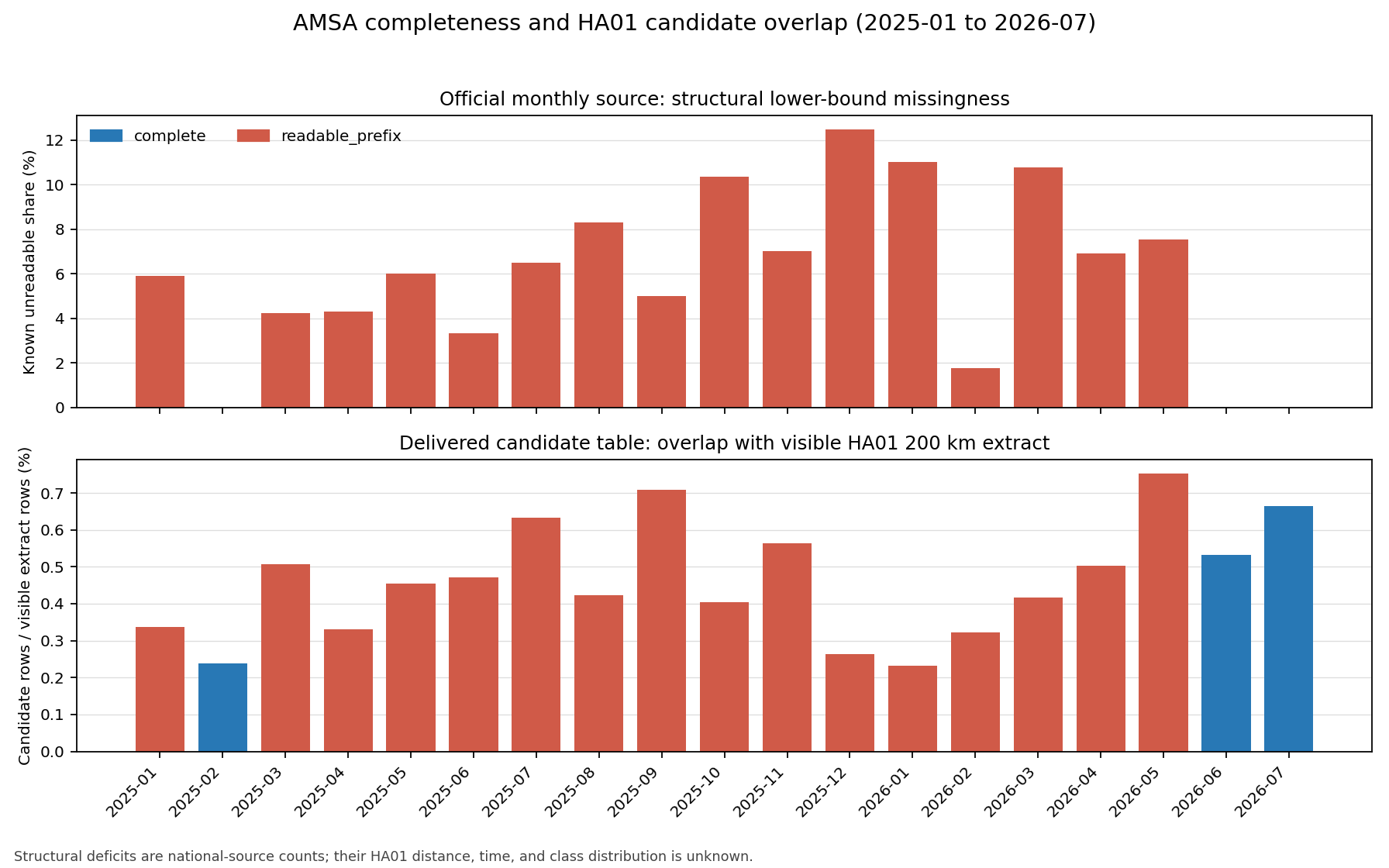
| Official AMSA monthly | 19 months, Jan 2025–Jul 2026; 46,955,460 readable of 49,897,448 declared national rows. Sixteen months are readable 2 GiB prefixes; three structurally complete. | Anonymous traffic and source/TL screening. | At least hourly thinning; no public registry identity; known 2,941,988-row structural shortfall. |
| H01W-centroid extracts | 159,925 positions within 200 km across the 19 months. | Full local population for the all-source 63 Hz screen. | “All” means all structurally readable rows in these extracts, not all ships everywhere. |
| Juan shortlist | 678 exact rows; 40 overlap the 12-hour waveform slice; 0.42% of the 159,925 H01 rows. | Exact RAM and selected waveform follow-up. | Range/class-selected, not representative. |
| ARA | 2,134 H10 rows delivered for Mar 31–Apr 1; eleven Aug area/time capture sets with 7,254 valid rows / 6,578 unique fixes. The three 20 Aug sets add 1,938 rows / 1,749 unique fixes. | Named row-level case geometry selected from multi-vessel regional exports. | Irregular capture periods and latest-known-position ages; not continuous tracks. The 20 Aug files overlap no held waveform interval and supply no true reported draught field; source, licence, CRS and units remain undocumented. |
| GFW | 177,775 H01W presence-hours plus bounded H03/H08/H10 context. | Hourly class/identity corroboration and context. | Gridded presence, not raw tracks or exact CPA. |
Common nominal-63-Hz expected-RL screen
This product ranks 103,851 source/receiver rows from 101,129 usable retained AIS source records. AMSA contributes 97,538 H01W records. ARA contributes 3,591 unique source records and 6,313 source/array pairs because H03 and H10 fixes can be evaluated against both retained array sides.
One propagation rule for every row
Every rank uses the published JOMOPANS-ECHO nominal-63-Hz decidecade source level and the same Juan-style range-only law. Exact RAM is never substituted into the ordering.
1900 ≤ r < 4800 m: TL_lite = 20 log10(1900) + 10 log10(r/1900)
r ≥ 4800 m: TL_lite = 20 log10(1900) + 10 log10(4800/1900) + 15 log10(r/4800)
Each branch adds 0.0035 × r_km dB. The ranked proxy is SL63 − TL_lite.
TL_lite is not tl_fast, spherical spreading or RAM. It has no bearing, bathymetry, water-column, seabed, source-depth or monthly-environment input. It is suitable for common-method triage only. The source model itself has roughly 6 dB scatter before propagation error.
Top five common-method rows
| Rank | AIS / array | UTC | Vessel / anonymous public ID | Class | Range km | Common RL proxy dB |
|---|---|---|---|---|---|---|
| 1 | AMSA / H01W | 2025-10-04 14:50:09 | CRAFT_ID 4765513744 | Bulker | 12.4 | 115.41 |
| 2 | AMSA / H01W | 2025-06-17 18:18:49 | CRAFT_ID 4552119639 | Bulker | 7.7 | 115.14 |
| 3 | AMSA / H01W | 2025-04-14 01:52:49 | CRAFT_ID 597855851 | Bulker | 16.3 | 111.66 |
| 4 | AMSA / H01W | 2025-10-25 15:21:19 | CRAFT_ID 4552119639 | Bulker | 10.1 | 111.35 |
| 5 | AMSA / H01W | 2025-04-27 07:20:22 | CRAFT_ID 1623730410 | Container ship | 8.2 | 110.42 |
Prominent cases on the same scale
| Case | Global rank | Array | Common RL proxy dB | Existing exact 63-Hz RAM diagnostic |
|---|---|---|---|---|
| Juan P3 high | 25 | H01W | 104.46 | TL exact − TL_lite = +4.82 dB |
| MAERSK DETROIT | 35 | H10S | 103.58 | +10.78 dB |
| Juan P1 high | 363 | H01W | 98.43 | +5.08 dB |
| Juan P2 high | 1,445 | H01W | 94.98 | +4.99 dB |
| CRETANSEA | 3,376 | H10S | 91.73 | +24.10 dB |
| Juan P4 high | 22,954 | H01W | 79.47 | +11.47 dB |
A positive exact-minus-common TL means exact RAM predicts more loss than the common law; it therefore implies a lower exact one-ship RL than the common proxy, holding source level fixed. These diagnostics use the existing fixed 6 m physical ship-depth convention. The common screen has no source-depth parameter.
Exact-path coverage and waveform opportunity
| Source | Frequency | Usable source records | Records with exact direct RAM | Coverage |
|---|---|---|---|---|
| AMSA | 63 Hz | 97,538 | 674 | 0.691% |
| AMSA | 80 Hz | 97,538 | 674 | 0.691% |
| ARA | 63 Hz | 3,591 | 5 | 0.139% |
| ARA | 80 Hz | 3,591 | 4 | 0.111% |
Juan P3 high, at rank 25, is the first row with a retained complete-triplet waveform overlap. The 24 higher-ranked rows have no retained overlapping waveform and are explicit future acquisition or analysis opportunities. Protected V8 rows remain sealed regardless of rank.
Frozen high-versus-low expected-RL pairs
Before reading new waveform outcomes, v11 pinned the complete 103,851-row common-method rank, a 10,923-row retained-waveform candidate screen, 1,681 eligible pair candidates, exact six-pair membership, receive-time bookkeeping, fixed 102.4 s windows, QC, eleven standard bands, and the 63 Hz primary outcome. The selection retained 209 sealed rows only for audit; no protected waveform was opened.
| Pair | Selection and coverage | High AIS time | Low AIS time | Proxy gap dB | Measured 63 Hz dB | Positive nodes |
|---|---|---|---|---|---|---|
| V11-P01 | H01W; same anonymous file-scoped AMSA CRAFT_ID and date | 2026-02-19 05:24:56 | 2026-02-19 14:49:57 | 36.0915 | +1.9075 | 3/3 |
| V11-P02 | H01W; same anonymous file-scoped AMSA CRAFT_ID and date | 2026-02-26 01:49:58 | 2026-02-26 10:09:54 | 23.2015 | +5.3840 | 3/3 |
| V11-P03 | H01W; same anonymous file-scoped AMSA CRAFT_ID and date | 2026-02-05 19:59:27 | 2026-02-05 11:19:57 | 20.3248 | +7.6725 | 3/3 |
| V11-P04 | H08S; different MMSIs matched on date, class, length and speed | 2026-08-12 16:59:35 | 2026-08-12 16:43:48 | 14.8968 | −0.8210 | 0/3 |
| V11-P05 | H10N; same retained MMSI and date | 2026-04-01 14:55:39 | 2026-04-01 12:23:43 | 12.6001 | −0.0775 | 1/3 |
| V11-P06 | H10S2–3; same retained MMSI and date | 2026-03-31 10:41:00 | 2026-03-31 16:29:32 | 17.9169 | +8.4077 | 2/2 |
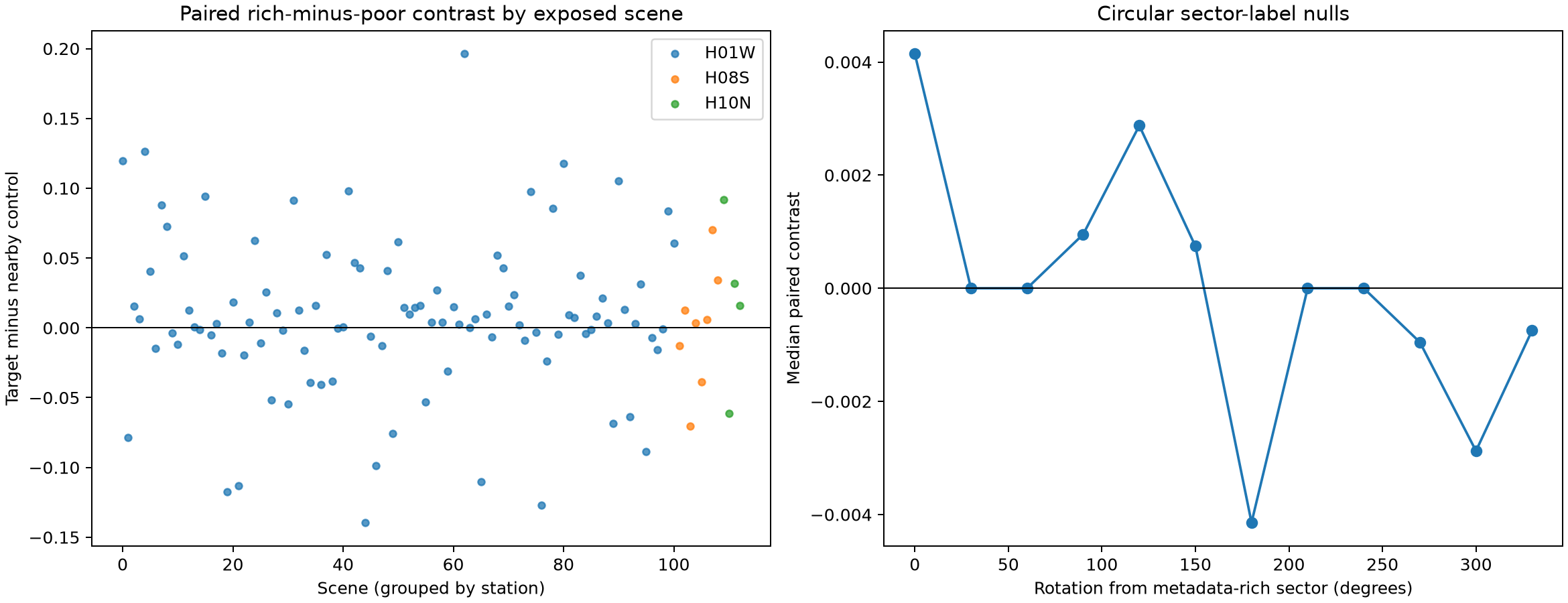
Four of six pairs were positive on every required node; three of five complete-triplet pairs were positive. The median measured contrast across pairs was +3.6457 dB. The proxy gaps spanned 12.6001–36.0915 dB and exceeded every measured contrast. The descriptive Spearman rank correlation was +0.3714 for six non-independent pairs; no p-value or independence claim is warranted. H03 was not tested because the ranked table contained no retained H03 waveform overlap.
H01W and H08S used magnitude-response-corrected nominal-pressure products that are not traceably calibrated. The frozen H10N and H10S pass used raw counts. Only within-node high-minus-low differences were interpreted; levels across response bases were not pooled. Environmental state and concurrent traffic were unmatched in every pair, and the H10S high window had already been exposed.
The pass read 870,400 samples and retained no waveform or PSD arrays. It produced 187 node-band rows in 2.29 s with peak RSS 214,884,352 bytes. An independent rFFT/Welch implementation reconstructed every selection decision and all 187 contrasts; the maximum contrast difference was 3.55e−15 dB and no sign differed.
Package: /home/rui/Documents/Codex/2026-08-15/ctbto-10-40-family-comparator/outputs/v11-expected-rl63-high-low-association/. Manifest SHA-256 4c1c03d767d3d7550d4ba2f11d0dca90766b5cac407d93cbfb86ac0091c72e50; result SHA-256 2bf0c294df7f971e1763518e9df4a98d4fda8e1951659ec34d0b1094d65c9734; independent-validation SHA-256 696fbec5ee0d8c9c9b274206977a8999e7d18908fc322d7a1c529280f65368b8.
Source and propagation ledger
Source convention
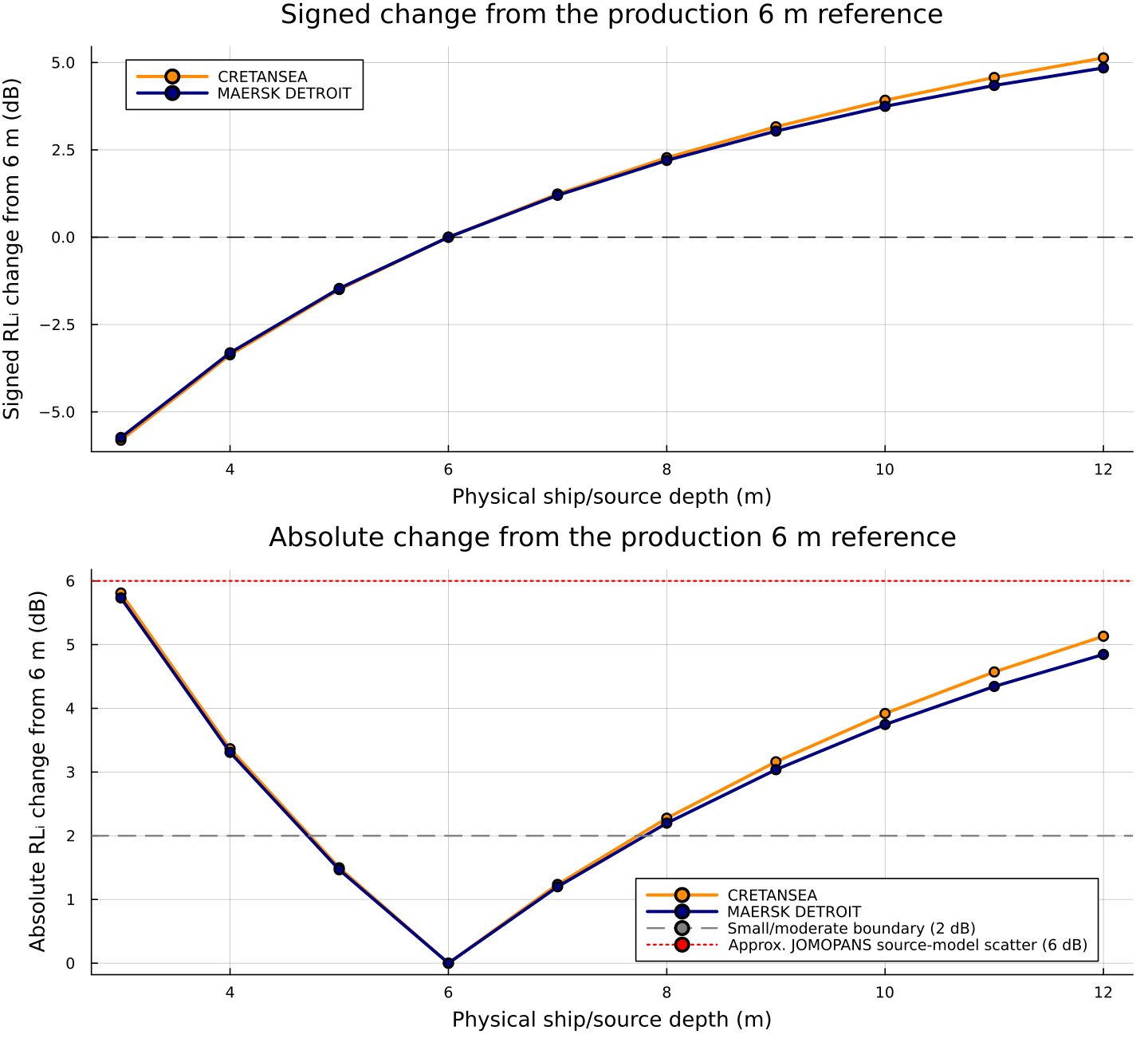
The default JOMOPANS-ECHO model uses ship class, length and speed, with roughly 6 dB model scatter. Production SL uses the published low-frequency equation and a fixed 6 m equivalent-monopole reference. Values below 20 Hz receive extra caution. A physical depth sensitivity does not automatically create an alternate RL: SL must be re-referenced consistently first.
| Product | Status | Frequency / depth / environment | Route and interpretation |
|---|---|---|---|
| Juan 678 paths | complete | 63, 80 Hz; 6 m; UTC-matched P1M monthly ocean fields | Exact direct RAM at H01W1. |
| Juan selected multi-frequency paths | complete | P1/P3/P4 at 25, 40, 63, 80, 100 Hz; 6 m; February P1M | Exact direct RAM. The corrected 30-row current-master summary uses frequency-sweep fields at 25/40/100 Hz and authoritative broad-results.csv values at 63/80 Hz; historical-runtime 63/80 remains separate. |
| Temporal environment pilots | complete | 63 Hz monthly/daily/nearest PT6H; July sentinel also 80 Hz; 6 m | Mixed-sign sensitivity; no global correction or automatic daily rerun. |
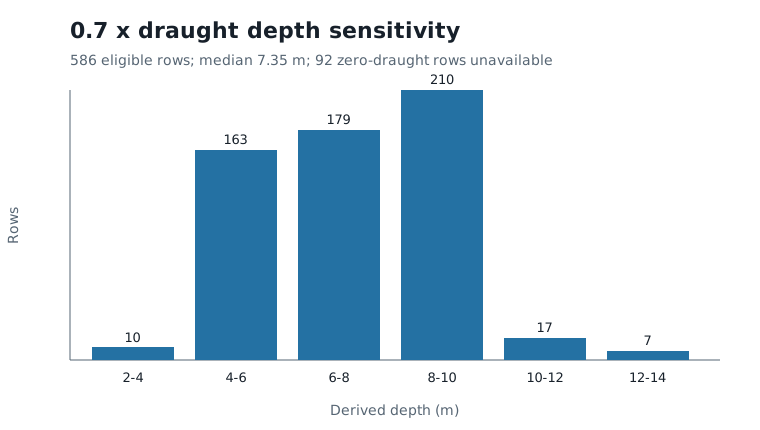
| Juan 0.7 × draught | complete | 63/80 Hz; exact alternate depth for 586 rows; monthly fields | TL sensitivity only; production remains 6 m; alternate RL not formed. |
| All-source H01W screen | complete | 159,925 rows; 63 Hz; H01W1; 6 m; same-month P1M | 678 reused direct anchors; 17,442 inside-hull interpolation; 141,805 flagged extrapolation. LOAO |error| median 4.06 dB, p95 15.28 dB. |
| H01W hourly aggregate shipping screen | complete | 24,278 gated rows; 23,813 source-model eligible; 11,251 receive hours; nominal 63 Hz; H01W1; 6 m; same-month P1M | Corrected JOMOPANS, range/1500 travel time, known-ID hourly deduplication and linear-power sum. Upper median/p95/p99/max 71.06/86.93/92.78/109.26 dB. |
| H01W February aggregate association | exploratory pass | 561 exposed response-safe hours; 27 dates; 106 six-hour blocks; nominal-T1 63 Hz triplet outcome | rho +0.1567 (cluster interval +0.0388..+0.2699); adjusted +0.1375 dB per 13.399 dB predictor IQR; within-block +0.1050; all nodes positive; same-time beats fixed future placebos. Strong UTC-phase heterogeneity; distinct-time replication required. |
| H01W August replication feasibility | temporal-coverage stop | 47 fully observed triplet hours; 46 response-safe; zero protected | The immutable predictor ends 31 July, so primary and +6/+24/+168 h overlaps are all 0/46 versus 36 required. No August acoustic value or replication protocol opened. |
| H01W February robustness/source class | post-outcome diagnostic | 27 leave-one-date-out fits; anchor-hour/block and phase exclusions; 11 bands × 3 nodes | All leave-date-out rhos positive 0.1271–0.1827. Rho 0.1164 without exact-anchor hours, 0.0915 without their blocks, 0.0499 without 00–05 UTC. All bands/nodes positive raw and within block; broadband, not 63-Hz-specific. |
| H01W July triplet and aggregate transfer | complete; frozen transfer failed | 10 July 00Z to 12 July 00Z; H01W1/W2/W3 EDH; T1 nominal; 46 primary QC hours | All three one-node requests completed without resend. Each returned 43,199,999/43,200,000 samples, missing only the final 0.004 s sample; 47/48 triplet hours complete. Frozen 63 Hz rho −0.2428, eight-block interval −0.5124..+0.0527; within-block −0.1047; all nodes negative; +6/+24 h placebos positive; 1/11 raw bands positive. |
| H01W July post-result morphology and source-arrival test | complete; exploratory / frozen null | 46 literal-QC eligible hours; nine fixed 102.4 s source-arrival windows; 50/63/80/100 Hz | Post-result atlas: local 25 Hz maximum in 38/46 hours and an eleven-hour run. Frozen source-arrival localization: 0/2 target clusters pass all four bands; target 2 passes only 50/63 Hz; context 0/4. |
| H10S primary paths | complete | 63 Hz; 6 m; 2026-03-31 daily field | Exact direct centroid paths and conditional RL context. |
| Official H10 response and additive v2 audit | complete; T1 provenance upgrade | H10N1–3/H10S1–3; target interval 31 March–2 April 2026; 143 response rows from 0.1–125 Hz per node | Official CTBT IDC RESPONSE:OPERATIONAL export, theoretical response. Relative to the frozen EarthScope basis, integer 10–100 Hz nominal-level deltas are −0.0009..+0.1826 dB. Same-node same-frequency ratios cancel; maximum retained H10S summary change 0.0186 dB and DIMIJOHN band change 0.00955 dB; no signs change. This does not establish T2, maintenance, uncertainty or H10S1 health. |
| CRETANSEA 13:46 exact path | complete | 63/80 Hz; 6 m; 2026-03-31; 50,472.883 m at receiver-centred 294.150066° | Exact direct RAM TL 93.8553/85.9887 dB; published-equation RLi 75.7936/80.3873 dB. Two 50 km smoke fields were truncated and excluded; accepted v2 encloses the endpoint at 50.5 km. |
| CRETANSEA upper band | complete | 80/100 Hz; 6 m; 2026-03-31 | Four exact current-master direct fields at 15:51 and 16:43. |
| H10S smoothing | complete | 63 Hz; 6 m; 2026-03-31; ±250 m range and 3–9 m depth kernels | Saved exact fields, incoherent intensity averaging. Range deltas +2.00, −0.30, −5.70 dB; depth deltas −0.26 to −0.31 dB. |
| Angular/range interpolation | bounded validation | 63 Hz; 6 m | Local angular tests mostly passed at 0.125°; one needed 0.0625°. Direct-TL interpolation passed two local sectors; complex-pressure range interpolation failed. No global fan. |
| H01W radial/angular pilot | complete; interpolation failed | 63 Hz; 6 m; February P1M; H01W1; eight 45° anchors plus four 22.5° holdouts | All 13 exact fields valid. Holdout median absolute TL errors 6.435/5.525/5.653/5.910 dB; phase medians 86.8–92.6°. The 45° and 90° sectors truncate near 113 and 190 km. No atlas or fan released. |
| Practical reciprocal first tiles | local refinement complete | 63 Hz; H01W/H10N/H10S; 3–10 m depth bank; complete 0.125° axes plus eight independent 0.0625° holdouts; 84/84 new rays | All four refined tiles still miss the ordinary-location target: median absolute TL error 0.377–0.742 dB and only 42.7–57.5% of holdouts within 0.5 dB. Complex-pressure interpolation also fails. These tiles stop at 0.125° and retain residual masks; no 0.03125° run. Exact direct RAM remains truth. The broader authorized 63 Hz campaign remains active on distinct tiles, but there is no 80 Hz product or atlas release yet. |
| Fast analytic TL | screen only | Usually 63 Hz | Ranking only; exact-path errors can be roughly 9–24 dB. |
| RAINDROP vs RAM | tiny validation | Bounded smoke case | Not adopted as production solver. |
| 3-D RAM / FIELD3D | not run | — | Reserved for a selected geometry that demonstrates need. |
Waveform analyses that have run
| Method family | Data categories | Status / ceiling |
|---|---|---|
| Bandpass and decidecade energy | H01W week/month/July and Juan pairs; H10S two-node events; H10N/H08/H03 scenes | run Relative T0/T1 contrasts, official-response H03 T1 bands and provisional scalar-anchored H10N bands at 12.5–100 Hz; exploratory rung-2 morphology. |
| PSD, FFT, spectrogram and spectral morphology | H01W, Juan, MAERSK/CRETANSEA, SEA DOLPHIN, H10N events; selected retained H03/H08/H10 products | run Main-report selected spectra and the completed H03 hourly derivative are T1 nominal pressure. H10N hourly bands remain provisional scalar-anchored magnitude products, not T2 ambient SPL. |
| Tonal persistence | 769 eligible nonprotected complete-triplet hours: H01W 688, H08S 46, H10N 35; separate H01W fixed-family scans | broad exposed catalog complete The 10–100 Hz pass retains 65 multi-node families in 40 hours: H01W 18/688, H08S 21/46, H10N 1/35. These are source-unlabelled relative-count ridges, not detections. |
| Coherence, phase, closure | Complete H01W, H03S, H08S, H10N triplets | run where retained Magnitude recalibration does not relabel or alter these counts-relative diagnostics. |
| Beamforming / directionality | Complete triplets only | active, deprioritized Delay-sum, MVDR, phase-slope, SRP-PHAT, distribution, envelope, spectrotemporal, sparse onset, cumulant and CSD/rank-fusion families run. Only EDS/HASE/HAG execution waits on access. |
| Association / matched contrast | H01W February and July hour/block products; Juan pairs | run February rho +0.1567 did not transfer to July (rho −0.2428; interval crosses zero); selected-pair ordering remains exploratory. |
| Official-response audits | H10S/DIMIJOHN retained products and H03 hourly bands | additive audits Official H10 T1 changes no reported sign. Official H03 T1 changes levels by +0.0526 to +0.6310 dB; seven strict 100 Hz signs change only where differences are at most 0.040 dB. |
| Non-shipping tags | 122 V12 pairs; 732 unique exposed/development intervals | bounded run Five clear exclusions; three ambiguous moving-frequency intervals retained; no whale identity. |
| Heaney CPA peak | Saved H10S event spectra reviewed | exact feature unrun Broad event-window rises are compatible only; no 60 s CPA-centred series or reconstructed CPA. |
The main report's local interactive explorer compares five selected T1 event products—Juan P1/P2/P3, MAERSK DETROIT and CRETANSEA 16:43—using retained node-median PSD curves and 11-band summaries. It does not embed raw or restricted values and does not imply a complete per-hour PSD or spectrogram atlas. The official H03 and provisional H10N hourly bands remain restricted and are summarized here by coverage rather than exposed in the report.
Broad persistent-tone catalog
The frozen all-frequency scan used raw integer counts and exact UTC-aligned hours. Each complete hour contains 875 periodic-Hann frames of 4,096 samples with 1,024-sample hops. The half-open 10–100 Hz search retains a local peak only if its time-median and frame prominence are at least 6 dB above a 0.25–2 Hz sideband background, its −3 dB width is no more than 0.25 Hz, at least half the frames pass, and the longest passing run is at least 120 s. Within-hour families match node candidates within 0.1220703125 Hz and require at least two nodes.
All 36 protected package-hours were excluded before status or waveform access. The scan processed 769 eligible hours and retained 344 node prefilter candidates, 65 supported multi-node families and 40 supported hours. Rates are H01W 18/688, H08S 21/46 and H10N 1/35. Descriptive complete-link grouping uses a 0.25 Hz maximum span after extraction and cannot rescue a failed exact-frequency rule. H03, H10S and August H10N archives remain outside this validated random-access pool.
A separate manual-detrend/FFT implementation replayed all 769 hours. Every hour decision and discrete candidate/family field matched; maximum numeric difference was 1.4388490399142029e−12 against a 1e−9 tolerance. The primary pass took 316.5 summed hour-seconds with 256,900 KiB peak RSS; replay took 169.3 s with 190,332 KiB peak RSS. Restricted compact derivatives remain mode 0600. No full waveform, PSD, spectrogram, prominence or cross-spectrum matrix was retained.
The two main-report examples were frozen from compact scalar ranking before their plots were regenerated: H08S 11 August 09Z at 73.1201171875 Hz and H01W 5 February 19Z at 12.5732421875 Hz. Each plot is per-node spectral level relative to its own simultaneous local background, so it supplies no absolute or cross-station amplitude comparison. The package is external at /home/rui/Documents/Codex/2026-08-15/ctbto-juan-measured-acoustic-followup/outputs/all-frequency-persistent-tone-discovery-v1/; manifest SHA-256 d8731f6f47aadad8ba176ab3c50dfc4712ccc1226396da9a44e0587f443f2f63, result SHA-256 385626abce857e7bfaf5f0f0a8dfb0e1306a68d403011a3eed73c428fd38e60f, validation SHA-256 0b58e3b582d8b27f6eed847a7147e65cd755b09f0f1a67d21f49b11337036a27.
Earlier H01W fixed-family scan
The earlier exploratory scan used the first 600 s of each of 47 complete H01W August hours and a different fixed rule. It found 48 Hz in 8/47 hours, 24.25 Hz in 6/47 and 31.25 Hz in 3/47; the separately frozen February recurrence result was 0/47 for all three. Its report-support package retains three selected T1 nominal-pressure spectrograms and metadata, not a full hourly matrix. It remains separate from the broad raw-count catalog.
AIS-first expected-RL-selected direction diagnostic
The frozen cohort contains five exposed, nonprotected H01W complete-triplet cases selected only by descending expected-RL proxy rank with a three-hour receive-centre separation. No tonal or horizontal-line field entered eligibility. Each 102.4 s window was divided into five 20.48 s cells. The pass evaluated three sound-speed assumptions per cell, for 15 records per case and 75 records overall.
Estimator inventory
| Estimator | Observable and operation | Disposition |
|---|---|---|
| Pooled 10–80 Hz exact-spherical GCC-PHAT triplet consistency | For each cell, cross-correlate the three node pairs after phase-only spectral normalization; compare the observed lags with exact-AIS spherical delays; require pair quality, closure, residual and wins over +90°, +180°, negated and node-swap geometries. | Applied unchanged to all five cases. |
| Full bearing/range spherical SRP-PHAT | Search a spatial grid for lag consistency rather than testing one AIS point. | Not used: it answers a different question and creates a severely aliased field. |
| HASE/PMCC/Bartlett | Estimate a far-field plane-wave arrival direction. | Not used: EDS/HASE/HAG execution is waiting; local PMCC was outside this tranche. |
| MVDR, phase-slope, envelope, onset, cumulant, rank-fusion and differential-CSD families | Alternative beam, phase, onset and multi-score summaries developed in V5–V21. | Not used: those development families were rejected or would create a new rescue score. |
| Family-C tonal direction | First requires a persistent line and a timing-compatible AIS row, then tests direction. | Not used: the new cohort was AIS-first and deliberately did not require a line. |
All five retained outcomes
| Emission UTC | Receive centre UTC | Common proxy dB | AIS bearing | Quality / strict cells | Exact minus best-null median | Status |
|---|---|---|---|---|---|---|
| 2026-02-21 02:49:40 | 02:49:47.876 | 107.4279 | 49.7658° | 3 / 0 of 15 | −0.08683 | disfavor |
| 2026-02-19 05:29:56 | 05:30:48.376 | 106.4395 | 67.1434° | 0 / 0 of 15 | −0.01226 | indeterminate |
| 2026-02-25 03:09:57 | 03:10:41.028 | 105.4543 | 64.6307° | 0 / 0 of 15 | −0.05875 | indeterminate |
| 2026-02-15 00:04:58 | 00:05:48.020 | 103.6577 | 44.8027° | 0 / 0 of 15 | +0.03408 | indeterminate |
| 2026-02-04 18:14:58 | 18:15:52.920 | 99.9155 | 64.2990° | 0 / 0 of 15 | −0.14027 | indeterminate |
Final status is 0 support, 1 disfavor and 4 indeterminate. The first case had three quality cells but none passed the strict exact-versus-null rule. The other four produced no quality cells, so they supply no directional evidence for or against the AIS point. An independent implementation reconstructed coordinate conversion, FFT/GCC-PHAT, peak interpolation, quality tests, null geometries, residuals and decisions for all 75 records; maximum numeric error was 7.55e−15.
Isolated package: /home/rui/.codex/chatgpt-official-preview-plus/worktrees/3af2/ctbto-2026/analysis/ha01-ais-first-expected-rl-direction/v1/ and sibling derived directory. Final manifest SHA-256 e62186d804c178fa12e1c10f66bba5922444721035d41bb277a2be393a1bbb0d; independent-validation SHA-256 940b20d9d0914875a06b1533182d3d1fec34b86d50b4fe50eee80878e4b5d630.
Exact case ledger
| Case | Measured evidence | TL statement supporting context | Claim boundary |
|---|---|---|---|
| H10S MAERSK, 2026-03-31 10:41 | T1; H10S2/S3; fixed 600 s event vs unmatched +24 h; +10.19/+12.09 dB at 40–80 Hz. | 63 Hz exact direct RAM, 6 m, 2026-03-31 daily field. Point 87.81 dB; ±250 m intensity average 89.81; 3–9 m depth average 87.55. | Two-node morphology, not detection. |
| H10S CRETANSEA, 13:46:09 | Receive time 13:46:42.6486Z lies inside the exposed 13:40–14:00 broad-upper episode; multi-vessel and reviewed-geophysical alternatives remain. | 63/80 Hz exact direct current-master RAM, fixed 6 m, 2026-03-31 daily field: TL 93.8553/85.9887 dB; published-equation RLi 75.7936/80.3873 dB. | Centroid one-ship context inside a mixed-source episode, not attribution. |
| H10S CRETANSEA, 16:43:10 | T1; H10S2/S3; +6.60/+7.57 dB at 40–80 and +13.95/+15.39 dB at 80–100. | 80/100 Hz exact direct RAM, 6 m, 2026-03-31: 89.46/88.89 dB. | Unmatched comparator; incomplete triplet. |
| H10S CRETANSEA, 15:51:18 | Exposed morphology context. | 63 Hz exact direct RAM, 6 m, 2026-03-31: point 101.20 dB; ±250 m 95.51; 3–9 m 100.89. At 80/100 Hz exact direct: 92.10/90.35 dB. | 63 Hz point is null-prone; do not mix lineages. |
| Juan P1 | T1 complete triplet; 63/80 Hz frozen contrasts +2.40/+5.53 dB; broad analysis rises through 100 Hz. | Current-master 25/40/63/80/100 Hz, 6 m, February P1M: model/measured sign agrees 3/5; disagreements at 25/100; no peak match; rho −0.1. | Exposed, direction disfavoured. |
| Juan P2 | T1 complete triplet; +0.29 dB at 63, −1.80 at 80; elevated comparator. | Not a promoted current-master conclusion in the three-band P1/P3/P4 comparison. | Confound/falsification case. |
| Juan P3 | T1 complete triplet; +9.54/+7.20 dB at 63/80; nine of eleven broad bands all-node positive. | Current-master 25/40/63/80/100 Hz, 6 m, February P1M: sign agrees 4/5; disagreement at 100; no peak match; rho +0.1. | Exposed morphology; direction disfavoured. |
| Juan P4 | Model/measured signs agree 5/5 from 25–100 Hz, but peaks differ and rho is +0.3. H01W sharp hourly template: 0/336; H08S transfer 0/40; H10N 0/41. | Corrected current-master five-band summary, fixed 6 m, February P1M. | Broadest conditional ordering lead only. The exact sharp P4 transfer failed; no spectral-shape match, contribution or attribution. |
| Exact 80 synthesis | 17/22; 12/17 without ±24 h; strict A–B/no±24 h 11/16. | No single TL convention supports the heterogeneous saved-product synthesis. | Marginal recurrence hypothesis only. |
| H08S exact-80 anchors | +0.196 and −0.547 dB; controls +1.373/+1.433. | No promoted exact-TL conclusion. | Mixed two-anchor evidence. |
| H01W July aggregate transfer | 46 QC hours; 63 Hz rho −0.2428, block-bootstrap interval −0.5124..+0.0527; all node rhos negative; 1/11 raw bands positive. | Hourly aggregate predictor uses nominal 63 Hz H01W1 TL screen, fixed 6 m and July P1M; zero exact-anchor hours in the selected interval. | Frozen distinct-time transfer unsupported/ambiguous; no absence inference. |
Completed, active and unrun
| Status | Items |
|---|---|
| completed | Common-method 103,851-row nominal-63-Hz expected-RL screen; all-source 159,925-row H01W nominal-63-Hz TL screen; 11,251-hour aggregate shipping-only forward screen; positive 561-hour exposed-February association; July H01W three-node acquisition and restricted package; frozen negative July aggregate transfer; July post-result spectral atlas and frozen two-cluster localization null; corrected Juan five-band comparison; official H10 response package and additive invariance audit; official exact-window H03 response package and five-node T1 magnitude derivative; 381-node-hour H03/H10N scalar-anchored provisional nominal-pressure derivative; August 11–13 waveform accounting across 18 requested nodes; CRETANSEA 13:46 exact 63/80 Hz path; H01W radial/angular pilot and failed interpolation decision; four-tile reciprocal adaptive refinement and its local hard stop; H10 source-class context audit; representative PSD and local selected-event explorer; bounded non-shipping tag audit; maps for all presented named and directional cases. |
| active | Exploratory shipping-signal discovery; comparison of the February–July aggregate reversal; prioritization of nearby loud-ship cases; exact 13–14 August sequential waveform queue under the validated 24-hour terminal-remainder mode; the broader authorized reciprocal 63 Hz campaign on distinct H01W/H10 tiles, with masks and exact rays retained; directionality as a supporting lane, though deprioritized. |
| waiting / scoped stop | August distinct-time replication has no overlap because the predictor ends in July. EDS/HASE/HAG execution awaits access. T2 absolute model-versus-measurement remains unavailable. The sparse H01W 45° pilot and the four adaptively refined reciprocal tiles fail their own interpolation targets and are locally stopped. Those scoped failures do not close the broader authorized 63 Hz campaign, exact direct paths or other exposed analyses. |
| not run | CPA-centred Heaney feature; production 3-D soundscape; exact direct RAM for every AMSA row; a validated continuous H01W angular atlas; traceable full-array ambient SPL; ship attribution; out-of-sample prediction. |
Artifact guide
| Purpose | Project path |
|---|---|
| Report taxonomy and draught distribution | analysis/report-simulation-analysis-taxonomy-v1/ |
| Response-family visual | analysis/report-calibration-scalar-family-v1/ |
| Scalar-anchored H03/H10N nominal-pressure derivative | analysis/scalar-anchored-provisional-nominal-pressure/v1/; restricted values in data/local/restricted/derived/scalar-anchored-provisional-nominal-pressure/v1/ |
| Official-response H03 T1 derivative | analysis/h03-official-t1-nominal-pressure/v1/; restricted values in data/local/restricted/derived/h03-official-t1-nominal-pressure/v1/ |
| Station-holdings map | analysis/report-station-holdings-map-v1/ |
| Selected-event PSD explorer | analysis/report-waveform-psd-explorer-v1/; reports/current-state-2026-08-19-revised/assets/data/ and assets/js/ |
| Heaney audit | analysis/heaney-shipping-peaks-audit-v1/ |
| Common retained-AIS 63 Hz expected-RL screen | analysis/global-ais-expected-rl63-screen/v1/; data/derived/global-ais-expected-rl63-screen/v1/ |
| Full H01W AMSA 63 Hz screen | analysis/ha01-full-amsa-tl63-all-source/v1/ |
| July H01W frozen aggregate transfer | /home/rui/Documents/Codex/2026-08-15/ctbto-juan-measured-acoustic-followup/outputs/h01-july-aggregate-association-v1/ |
| July H01W post-result atlas and source-arrival test | /home/rui/Documents/Codex/2026-08-15/ctbto-juan-measured-acoustic-followup/outputs/h01-july-saved-product-event-spectral-atlas-v1/; …/h01-july-source-arrival-localization-v1/ |
| Official H10 response package | analysis/ctbto-idc-h10-response-2026/v1/ |
| CRETANSEA 13:46 exact path | data/derived/h10-cretansea-134609-direct-v1/ |
| H01W radial/angular pilot | analysis/ha01w-radial-angular-atlas/v1/ |
| Practical reciprocal TL atlas | analysis/reciprocal-tl-atlas/v1/; data/propagation/reciprocal-tl-atlas/v1/ |
| TL smoothing | analysis/tl-point-vs-smoothing-v1/ |
| Representative PSD | analysis/report-representative-spectral-spl-v1/ |
| Non-shipping tags | analysis/nonshipping-dominance-tags-v1/ |
| Maps and inventory | reports/current-state-2026-08-19-revised/assets/maps/ |
| Canonical project status | docs/PROJECT_STATE.md; docs/DATA_INVENTORY.md; docs/STUDY_DESIGN.md |
This companion summarizes validated local products. Restricted waveform values are not embedded or copied. The original report at reports/current-state-2026-08-19/index.html is preserved.