Juan Domingo Gonzalez
Traffic selections, workbooks, tracks, and monthly views
Juan supplied the tables and figures that anchored the H01W screening lane and the exact 26 March track reconstruction.
Collaborator record
Juan and Igor are collaborators, not labels on a task list. This page keeps their dated requests and contributions visible, ties each one to retained project inputs and checked results, and states plainly what matched, what failed, what was delivered, and what remains incomplete or unavailable.
Current reading
It reproduces the intended H01W event, track, hydrophones, and broad spectral processing. Juan’s subsequent source-spectrum test is also complete and unfavorable: the three hydrophones do not infer one consistent source spectrum under either seabed treatment. Neither result validates absolute sound-pressure level, direction, or ship attribution.
Collaborator roles
Juan’s work chiefly defines traffic screens, exact case tables, track geometry, and monthly diagnostics. Igor’s requests chiefly probe maps, spectra, direction, source depth, and what can be seen in the waveforms.
Juan Domingo Gonzalez
Juan supplied the tables and figures that anchored the H01W screening lane and the exact 26 March track reconstruction.
Igor
Igor’s questions pushed the project to make the propagation and waveform evidence inspectable—and to state where it does not support attribution.
How to read the timeline
What arrived or was asked? How did the project test it with retained inputs? What matched or failed? What remains missing?
The preserved message, note, workbook, PDF, or screenshot that defines the item.
The retained inputs, declared method, and bounded comparison used to test it.
The reader-facing table, figure, explorer, or checked package now available.
The part that remains partial, unavailable, or unsupported instead of being waved away.
Timeline
The 25 August audit was a useful checkpoint, but several statuses changed after the dense-track closeout, the reconstruction of Juan’s and Igor’s intended plots, the January 63 Hz closeout, Igor’s later calibrated-looking renders, and Juan’s completed frequency-dependent TL request.
Igor
8 Aug 2026A direct WhatsApp screenshot is retained at sources/user/igor_messages_ha10.png.
Igor asked about cargo ships at least 180 m long, moving at about 10 kn near H10, and wanted modeled noise estimates at H10 and other stations. He also asked for surrounding ARA traffic data.
The project later retained bounded ARA snapshots and completed exact H10 propagation comparisons for observed cases. It did not turn those observed passages into the specified hypothetical multi-station sweep.
The later H10 work answers related observed-case questions, but it does not answer Igor’s stated 180 m, 10 kn scenario. The two must not be presented as the same result.
The hypothetical still needs a frozen route or passage geometry, station set, source definition, and coverage decision before it can be computed as a distinct result.
Juan Domingo Gonzalez
10 Aug 2026Direct WhatsApp text and two PDFs are retained under sources/user/juan_2026-08-10/.
Juan sent preliminary February plots for H01W and wrote that the remaining step was to select, within one hour, the moments with the largest combined modeled shipping level.
The project recovered the later 678-row workbook, the exact TL-lite rule, and the overlap with retained waveforms. It then froze a stricter reproducible follow-up: four non-overlapping higher-versus-comparison windows drawn from the same month-scoped anonymous AMSA rows.
The collaborator idea turned into a bounded comparison that can be replayed exactly. Three of four pairs were louder at both 63 and 80 Hz, but none passed the complete three-hydrophone direction rule.
No retained source shows that Juan reviewed or accepted the project’s stricter replacement for his original hourly-combination note.
Juan Domingo Gonzalez
13 Aug 2026Forwarded WhatsApp bundle is retained under sources/user/juan_2026-08-13/.
Juan sent the Australia analysis workbook, monthly diagnostic PDFs, and a clear proposal: add a RAM transmission-loss column so he could reprocess and compare it against TL-lite.
The project matched all 678 rows back to the retained official AMSA extracts, recovered the exact TL-lite script, and ran direct RAM for the H01W paths. It now retains both the 678-row 63 Hz fixed-versus-geology-informed comparison and the completed 720-case dense-track direct-TL package for Juan’s later exact track.
Juan’s table is now reproducible against the retained inputs. The RAM comparison exists, and the project can say exactly where TL-lite and direct RAM agree or diverge.
The local record still does not show Juan’s promised own reprocessing or a collaborator-approved final comparison table built from his side.
Juan Domingo Gonzalez
14 Aug 2026The paper and its receipt are retained under sources/user/juan_2026-08-14/.
Juan supplied Heaney et al. as a visual reference, especially its Figure 9 style for a compact event-hour display.
The project answered that prompt with a versioned one-minute H01W display over 10:10–11:10 UTC, keeping all three hydrophones and both 63 and 80 Hz decidecade bands.
The display exists and is replayable. It shows a shared broad rise, but the peaks do not align tightly enough across hydrophones to support direction or attribution.
Visual resemblance to a published figure does not turn the result into ship attribution, and the page now says that directly.
Igor
14 & 19 Aug 2026A brief 14 August note mentions direction and source-depth sensitivity. The fuller 19 August record is igor-tmp. Both are contemporaneous local notes about Igor’s requests, not preserved messages from him.
The notes attribute four concrete wants to Igor: presentable H01W maps, spectral views for selected cases, a direction test that beats wrong directions, and a check of 0.7 × draught source depth.
The project produced four H01W propagation maps, representative power-spectral-density views, a complete-three-hydrophone direction test, and a row-wise 0.7 × draught sensitivity. It kept those lanes separate so a map, a spectrum, a direction test, and a depth sensitivity cannot be confused as one result.
The four maps are checked historical propagation context, but they are not maps of named Juan-selected cases or modeled ship-noise contributions, so that part of the request remains partial. Spectral views exist. The direction test gave zero supporting cases, one disfavored case, and four indeterminate outcomes. The retained 0.7 × draught study covers 647 of Juan’s 678 rows. Current policy now requires a 6 m received-level branch and also a 0.7 × draught branch when draught is observed or supplied by an admitted reliable inference method; registry design draught remains labelled inferred.
There is still no finite project-wide catalogue for excluding obvious non-ship signals, and the project has not validated Igor’s own beamforming method on real ship data.
Juan Domingo Gonzalez
19–24 Aug 2026Earlier monthly PDFs are retained under sources/google-drive/analysis/juan-2026-08-19/. Revised Drive files modified on 24 August were synchronized and checked on 27 August under sources/google-drive/analysis/juan-2026-08-26/.
Juan supplied monthly received-level, source-level, transmission-loss, speed, and loudest-case diagnostics. The later versions are distinct revisions except for one transmission-loss PDF that rendered identically to the retained copy.
The project rendered and inspected the PDFs, kept them as collaborator diagnostics, and used the monthly question to motivate a bounded January screen from project-owned tables and matched reciprocal propagation fields.
The January 63 Hz result is complete: 1,800 historical-fixed and 1,800 geology-informed fields support 1,411 eligible anonymous AMSA rows. The median geology-informed-minus-fixed transmission-loss difference is +3.80 dB. The corresponding 80 Hz solver fields have finished on Pazuzu, but they remain outside scientific interpretation and visualization until their closeout and derivative receipt is sealed.
Juan’s PDFs remain internal visual diagnostics: their labels are not always unambiguous, and no source tables, generating code, data dictionary, or redistribution permission accompanied them. The checked January result is therefore a project derivation, not a verbatim replay of the PDFs.
Juan Domingo Gonzalez
26 Aug 2026Read-only Drive sync is retained under sources/google-drive/SYNC_2026-08-27T0900Z.md.
Juan’s Drive folder added the exact `australia_26_03_26_extended_datos_buques.xlsx`, revised PDFs, and a map HTML export.
The project retained the exact workbook, sanitized the HTML, rendered the PDFs, and compared the XLSX cell by cell against the already incorporated CSV export.
All 319,590 workbook cells match the retained CSV export after removing the generated index column. The new Drive material closes source provenance for the 21,306-row dense track but does not change the scientific conclusion by itself.
The workbook still does not declare its timezone or CRS explicitly, so those remain collaborator-provided working assumptions rather than independently proved metadata.
Igor
27 Aug 2026Two JPEGs and their captions are recorded under analysis/h01w-lloyd-mirror-candidate-20260326/v1/igor-calibrated-views-20260827/.
Igor forwarded a three-hydrophone power spectral density plot and spectrogram for the 26 March H01W event and described both as calibrated.
The project treated the images as externally supplied views. It compared their shapes and marked times locally, but did not use them to replace the retained numerical waveform summaries because the response curve, estimator receipt, numerical arrays, uncertainty, and explicit timezone marker were not supplied.
The images are useful evidence of the intended event and broad processing. Igor’s three marked minima fall within 54 seconds of Juan’s reconstructed closest approaches, but the images do not establish traceable absolute sound-pressure levels.
A reusable calibrated measurement still requires the underlying numerical arrays and enough response and estimator information to identify how they were produced. The original JPEGs remain local.
Juan and Igor
27 Aug 2026Checked package: analysis/h01w-lloyd-mirror-candidate-20260326/v1/igor-juan-plot-intent-reconstruction-v1/.
This work answers the strongest shared collaborator question: do Juan’s track plot, Igor’s power spectral density curves, and Igor’s spectrograms reflect the same retained event, hydrophones, and broad processing intent as the project record?
The project reused the exact 21,306-row track, the exact H01W1–3 waveform bytes, and existing historical-fixed and geology-informed direct propagation results. No propagation rerun was needed. An independent replay checked all forty recorded outputs, and visual review passed.
Juan’s closest approaches reproduce within 3–4 s and 4.3–6.1 m in the event window. Igor’s spectral shapes correlate 0.9957–0.9960 with 0.43–0.45 dB residual error after one constant offset per hydrophone. Broad 35–85 Hz spectrogram time profiles correlate 0.775–0.816, while fine morphology correlations are 0.233–0.313. The event and broad spectral processing are reproduced; the available material does not validate absolute sound-pressure levels.
The original side-by-side composite remains local because it contains Igor’s restricted JPEG renders. This page uses only regenerated figures made from retained project data. No ship attribution follows.
Timing difference; range difference is 4.3–6.1 m.
Correlation after one constant offset; residual error is 0.43–0.45 dB.
Broad 35–85 Hz time-profile correlation; fine morphology is 0.233–0.313.
Igor’s visual estimates minus Juan’s three closest-approach times.
63 Hz correlation, historical fixed to geology-informed; at 80 Hz it is 0.363 → 0.410.
All recorded checks passed, and the four shareable figures passed visual review.
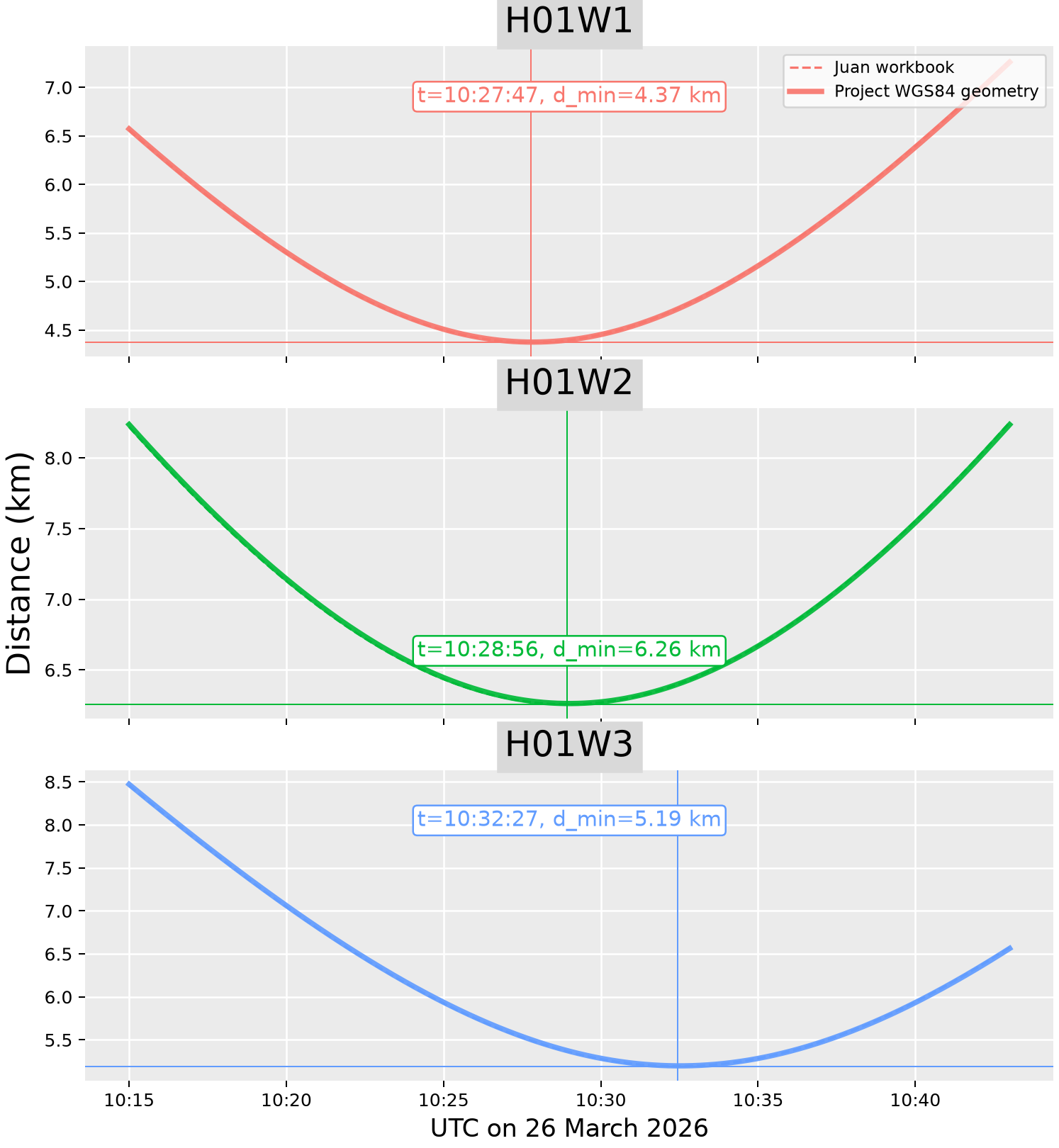
The project WGS84 geometry sits almost on top of Juan’s minima during the event hour.
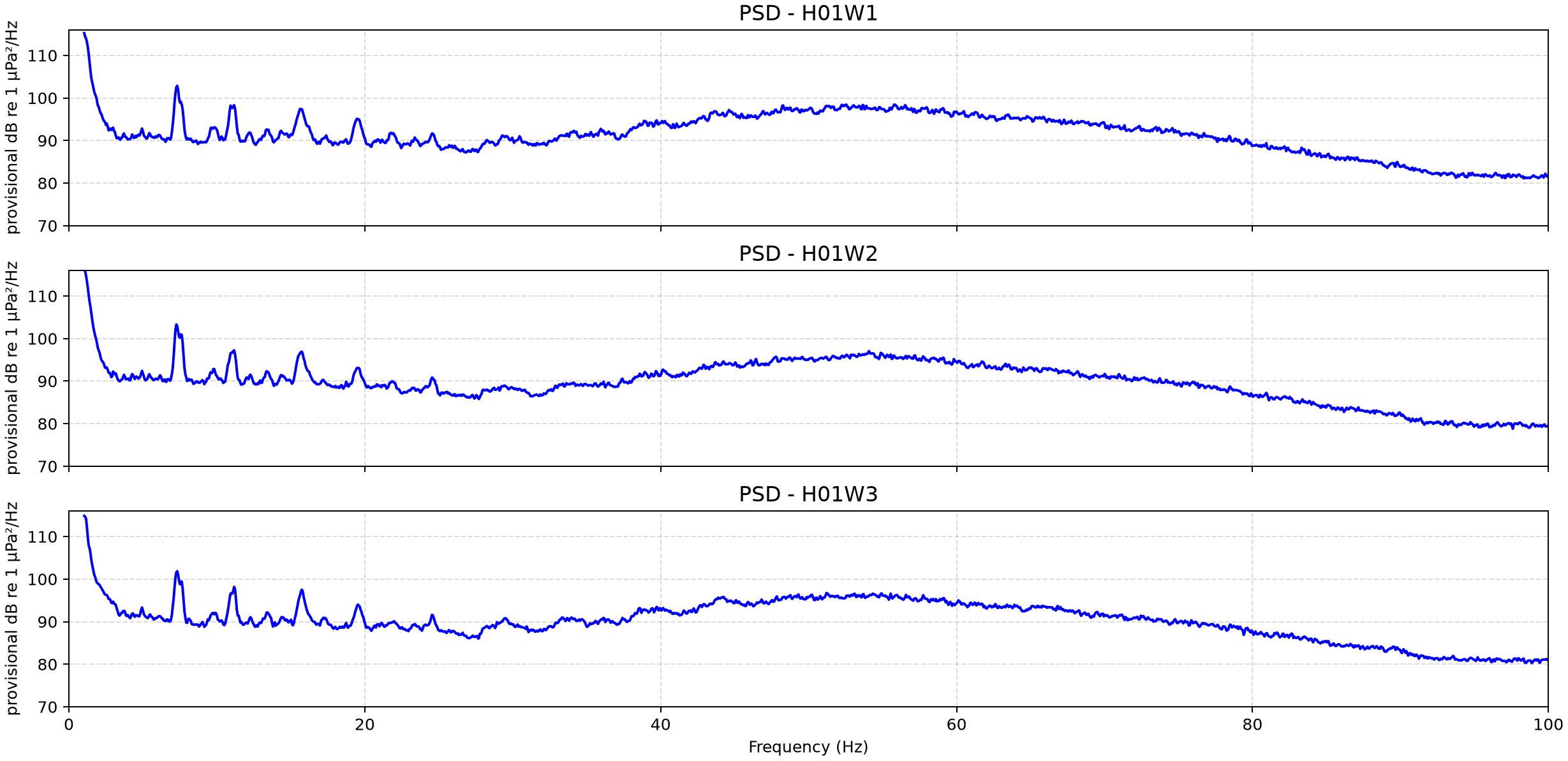
The broad spectral shape is nearly identical after one constant offset per hydrophone.
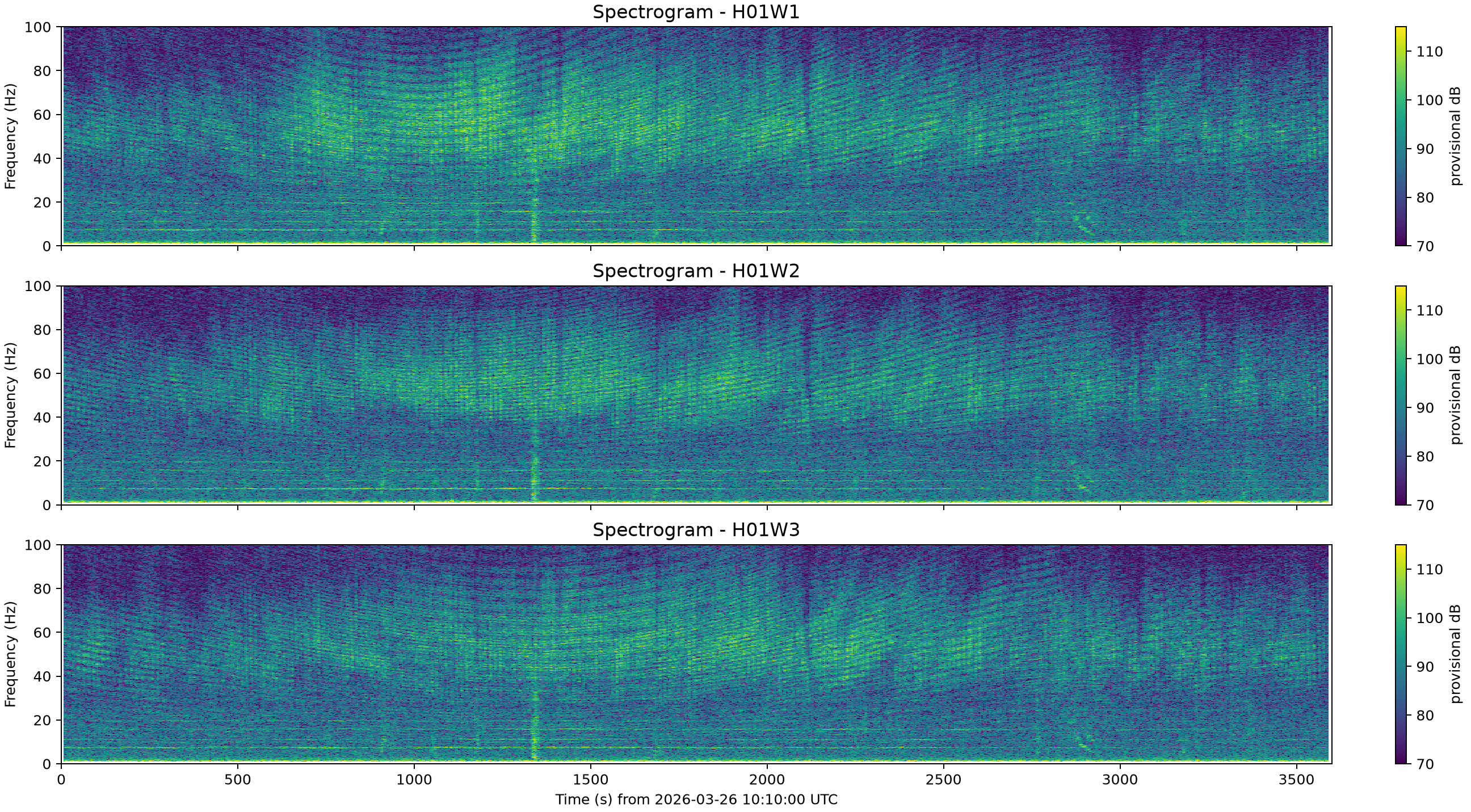
The broad arches and hour-scale rise are recovered even though the fine pixels are not.
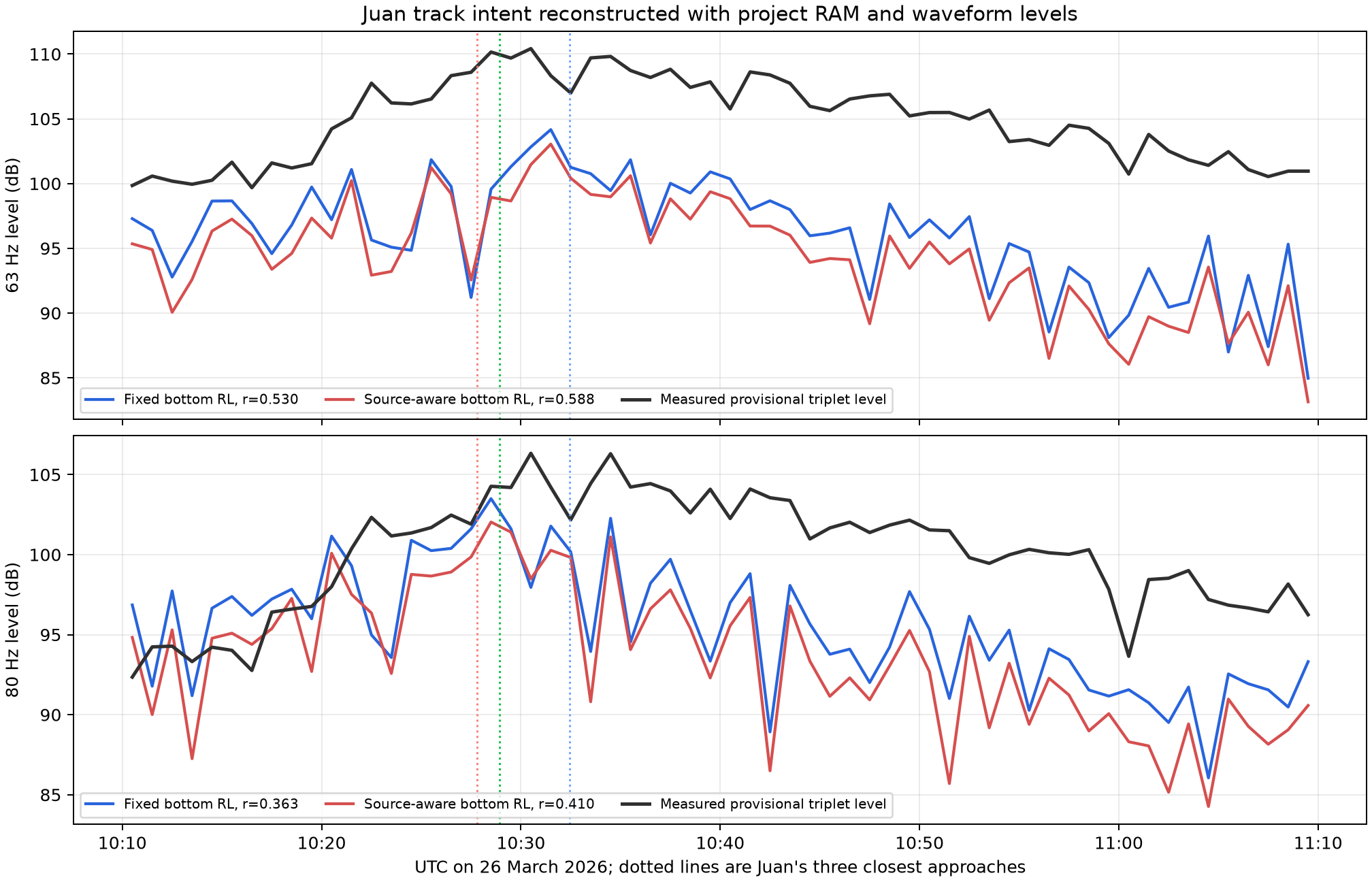
The geology-informed branch has modestly higher correlations than the historical fixed branch at both frequencies, but neither branch identifies the vessel.
Juan Domingo Gonzalez
27 Aug 2026 · 14:02 UTCA direct WhatsApp follow-up is retained locally. Its accompanying track image is not included here while its ownership and sharing status are being classified.
Juan asked for transmission loss from a source at 0.7 × draught to H01W1–3 over roughly 1–100 Hz. His proposed comparison adds the modeled loss back to the measured power spectral density to infer a source-level spectrum, then compares that spectrum with JOMOPANS-ECHO. He also reported that his own JASA search found no Lloyd’s Mirror paper using IMS, CTBTO, or deep hydrophones. That is a collaborator’s search observation, not a systematic review. He said he would omit dates and the ship identity from presentation figures.
The project completed the bounded calculation for the exact 26 March track and travel times, a 6.16 m source depth—the 0.7 × draught value for this ship—all three hydrophones, both retained seabed descriptions, and eleven decidecade frequencies from 10 to 100 Hz. It combined 198 checked transmission-loss cases with arrival-centred 60-second waveform spectra and compared the three independently inferred source spectra with JOMOPANS-ECHO and its ±6 dB model range.
The requested reconstruction is complete, and it is unfavorable. With the historical fixed bottom, only 6 of 33 frequency-and-time groups agreed across all three hydrophones within 6 dB, and only 7 of 33 agreed with JOMOPANS-ECHO within ±6 dB. The geology-informed bottom gave 4 of 33 and 5 of 33. Median cross-hydrophone spreads were 9.51 and 9.60 dB; median inferred source levels were 12.28 and 13.29 dB above the model. Changing the bottom does not rescue the comparison.
The calculation is finished, but the measured pressure basis still uses a provisional scalar and pooled response rather than a traceable absolute calibration. The result therefore cannot validate an absolute source level, identify the vessel, or support attribution. Juan’s search result is one collaborator’s literature-search observation, not a systematic review or evidence that the literature is empty.
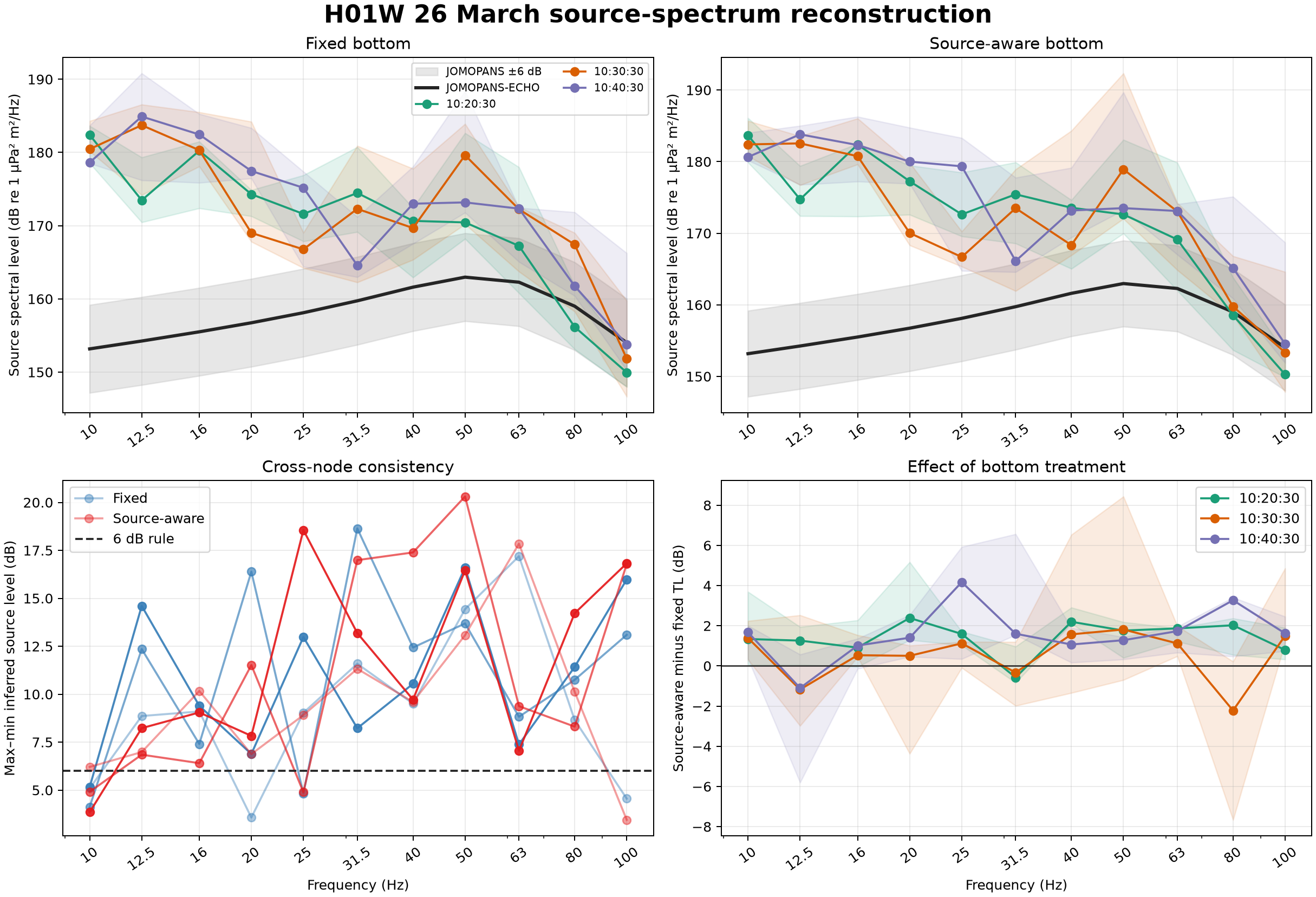
The three hydrophones do not recover one consistent source spectrum under either seabed treatment, and most values lie above the JOMOPANS-ECHO model range.
Open items
Several collaborator-facing ideas remain bounded by missing provenance, unavailable arrays, or deliberately unrun science lanes.
Juan’s requested 10–100 Hz calculation is complete and unfavorable under both seabed treatments. What remains is not another transmission-loss sweep: it is a traceable H01W response and pressure calibration, plus Juan’s review of the result, before any absolute source-level interpretation could be reconsidered.
A direct screenshot preserves the idea of modeling a hypothetical cargo passage near H10 and checking multiple stations. Later ARA holdings and observed H10 cases do not answer that scenario; its geometry and coverage still need to be fixed before computation.
Several bounded exclusions exist inside specific analyses, but there is still no finite collaborator-approved cross-case catalogue that says which transient, whale, or machinery-like patterns should be discarded before comparison.
The site now shows what the project replayed and delivered, but the retained record still does not contain Juan’s own post-RAM comparison table or Igor’s machine-readable calibrated arrays.