CTBTO 2026

Current answer

What the evidence supports

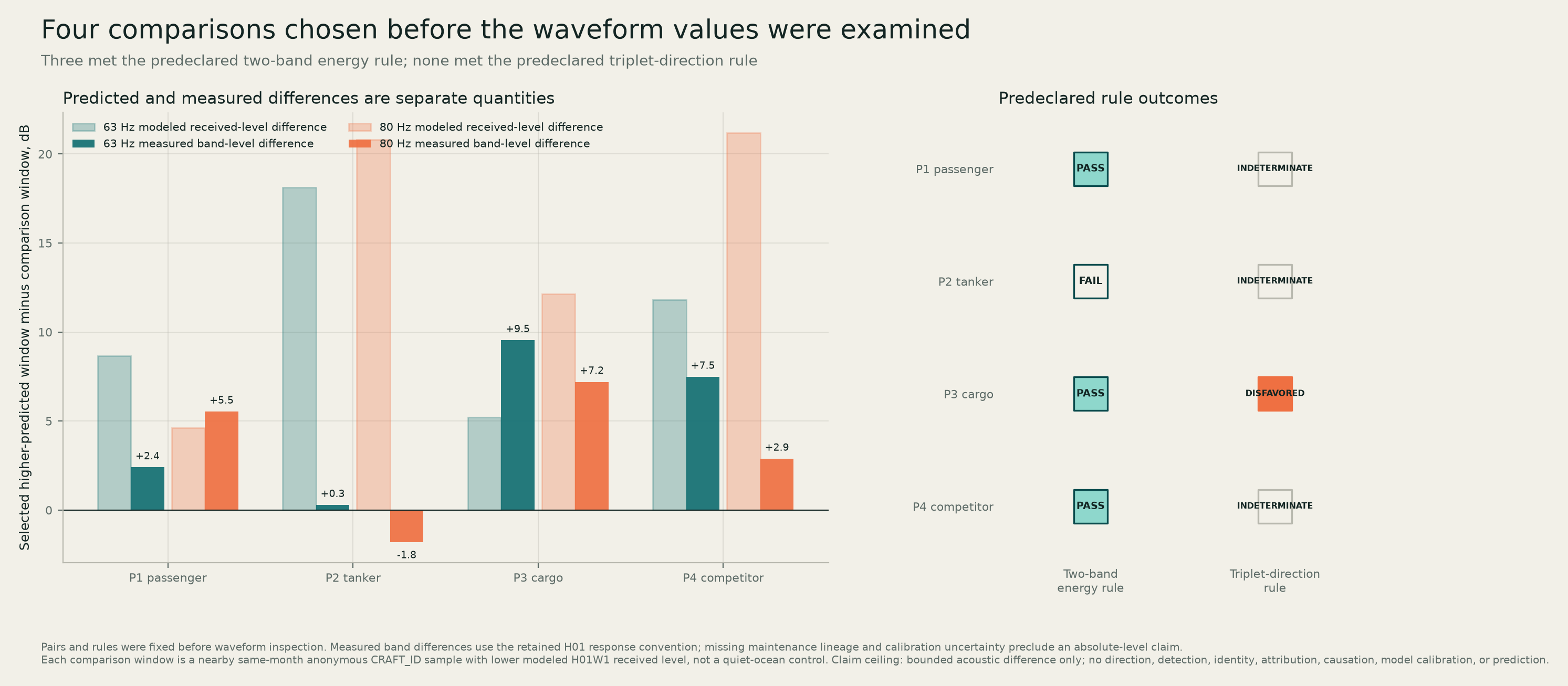
AIS traffic characterization is established. The expected energy sign appears in 3/4 preselected H01W comparison pairs, while 0/4 pass the complete directional check. The present evidence therefore stops before ship-specific attribution or out-of-sample prediction.

1

Traffic characterization

established

Inside 200 km of H01W, AMSA contributes 159,925 raw AIS records. Of these, 97,549 support SL and fast TL; 62,376 remain traffic-mapping records because source-input or quality-control rules fail. The 56 kn exclusion is a different record; Igor remains source-model eligible.

2

Higher versus lower acoustic exposure

bounded evidence

The frozen screening contrast is positive at both 63 and 80 Hz in 3/4 preselected higher/lower pairs. Those modeled values are screening estimates, not accepted RAM one-to-one results; the sample is small and selected in advance.

3

Repeated directional consistency

not reached

Spatial products describe cross-hydrophone consistency. They do not establish a ship direction.

4

Ship-specific attribution

not reached

Modeled SL, TL, and predicted individual RL do not identify a measured ship contribution on their own.

5

Out-of-sample prediction

not reached

The declared propagation and observation branches are not yet complete enough for an independent predictive test.

Forwards from source

Source Level (SL)

Inspect one source spectrum or compare distributions across AIS sets.

JOMOPANS-ECHO model

Change ship class, length, speed, and frequency while keeping the output as source spectral density.

AIS acoustic explorer

Choose any named AIS set and inspect SL, fast TL, or predicted RL for one of 102,629 AIS records across 5–100 Hz.

SL across AIS sets

Compare SL distributions for all AIS, AMSA, ARA RAM, AMSA RAM, AMSA non-RAM, Juan 674, and the Highlighted 21.

Transmission Loss

RAM one-to-one

Quality Speed

Use it whenever a validated direct-path result exists.

One source position to the receiver geometry defined by its result family, without angular interpolation.

Browse 1,014 results across two scientifically separate families.

RAM sweeps

Quality Speed

Use it where validated angular interpolation covers the path.

The browser exposes each declared receiver-centred key and its current state. Available sweeps open as geographic fields and selected TL-by-range traces.

Fast TL

Quality Speed

Use it for quick screening, not as a RAM result.

Browse the range-only estimate used for all 102,629 AIS records.

How each AIS record gets its TL

The daily sweep applies to the bounded 2026 March 31 and April 1 ARA group. The fast TL method serves its designated screening population; it does not fill a RAM gap.

RAM sweep coverage

See which declared set-level TL fields exist, which have partial downstream RL, and which still require direct paths.

Predicted RL

RAM one-to-one RL for Highlighted RAM AIS records

SL (dB re 1 µPa² m² / Hz) · line and ±6 dB source-model scatterRL (dB re 1 µPa² / Hz) · discrete pointsTL (dB) · discrete strokes

SL is evaluated every 1 Hz from 10–100 Hz, with exact 12.5 and 31.5 Hz values added. RAM TL and RL remain discrete at 11 nominal decidecade centres; no curve between them is implied. Click the chart to inspect a centre.

SL—
TL—
RL—
Source depth—
Technical details

Juan values

20 records × 11 frequencies: 220 values at 6 m and 198 additional values at 70% draught for the 18 records that have that branch.

Highlighted RAM RL

The selector above includes all 21 highlighted paths. All have results at 6 m; 19 also have results at 70% draught: 440 values in total. Igor contributes 11 values at 6 m and 11 at 6.16 m from an inferred repeated same-transit 8.8 m draught.

Predicted RL with fast TL

All 102,629 AIS records have SL and predicted RL from one vessel evaluated at all 96 integer frequencies from 5 through 100 Hz.

Open the AIS acoustic explorer →

Highlighted ship acoustics

Inspect SL, RAM TL, predicted RL, and measured SPL for the complete Highlighted 21, including Igor’s isolated record.

Open the Highlighted explorer →

RL across sets

Compare all-AIS screening distributions, RAM distributions for the Highlighted 21, and each Highlighted record across frequency.

Backwards from waveform

Waveform coverage and response

See what waveform support exists, which response route is admissible, and where coverage stops.

Waveform coverage

A small mark means one or more bounded waveform intervals start in that month. It never means continuous month-long waveform coverage.

Year
20252026
Month
JanFebMarAprMayJunJulAugSepOctNovDecJanFebMarAprMayJunJulAug
HA01
HA03
HA08
HA10

Waveform products

The 217 available hydrophone product families include guarded 5–100 Hz nominal pressure, summaries, periodograms, spectrograms, sliding Welch PSD, and tonal tables. Twenty requested hydrophone intervals returned no data, 20 H08N intervals lack a usable full-complex response, and one interval lacks context coverage.

Gap rule

Real gaps remain masks. Processing never bridges them for timing, phase, coherence, or beamforming.

Governing evidence

Response bindings

All 16 active full-response bindings pass the rounding-aware 10 Hz check. This establishes nominal-response standing, not traceable calibration.

Current ARA review

Inspect 32 hydrophone windows, complete and blank hours, band summaries, and tone candidates without treating them as ship detections.

Backwards across sets

See coverage, RL distributions, anomaly distributions, and spatial standing without collapsing stations or hydrophone arrays together.

Compare measured sets

Summarize the available waveform products across stations, hydrophones, hydrophone arrays, and target windows.

Observed spectra and time-frequency views

Each view keeps exact UTC support, hydrophone membership, response basis, gap masks, and AIS arrival markers visible. Arrival markers are timing context, not detections.

Spectrogram

Inspect time-frequency energy on the available waveform support.

Welch PSD

Inspect sliding power spectral density with the same gaps and response basis.

Band summaries

Compare guarded standard-band summaries without filling missing support.

Tonal tables

Lists candidates for hydrophones and hydrophone arrays while preserving their distinct identities.

Cross-hydrophone consistency

These views compare hydrophones within one array. They describe consistency, not ship identity.

Combined magnitude

Inspect 79 magnitude families for hydrophone arrays, formed by averaging aligned hydrophone power in linear units. At station HA03, only phase-invariant magnitude, coherence, and matrix energy are available because inter-hydrophone timing is not established.

Phase and GCC-PHAT

Inspect 63 full-complex bundles where timing support allows phase and lag views. These do not establish a bearing.

Percentiles and anomalies

Summary views remain separate from the underlying recording intervals and keep support limits explicit.

Percentile spectra

Shows 35 available spectra for hydrophone arrays; 44 hydrophone array intervals do not meet the support threshold.

Standardized anomalies

One hundred thirty-three hydrophone and 48 hydrophone array targets pass their support and stability checks after excluding their own target hour.

Unavailable anomaly targets

One hundred twenty-five hydrophone and 31 hydrophone array targets remain insufficient after the allowed fourth baseline block. No fifth block is permitted.

Estimator stability

This is observation-method QA on identical waveform support, not prediction validation.

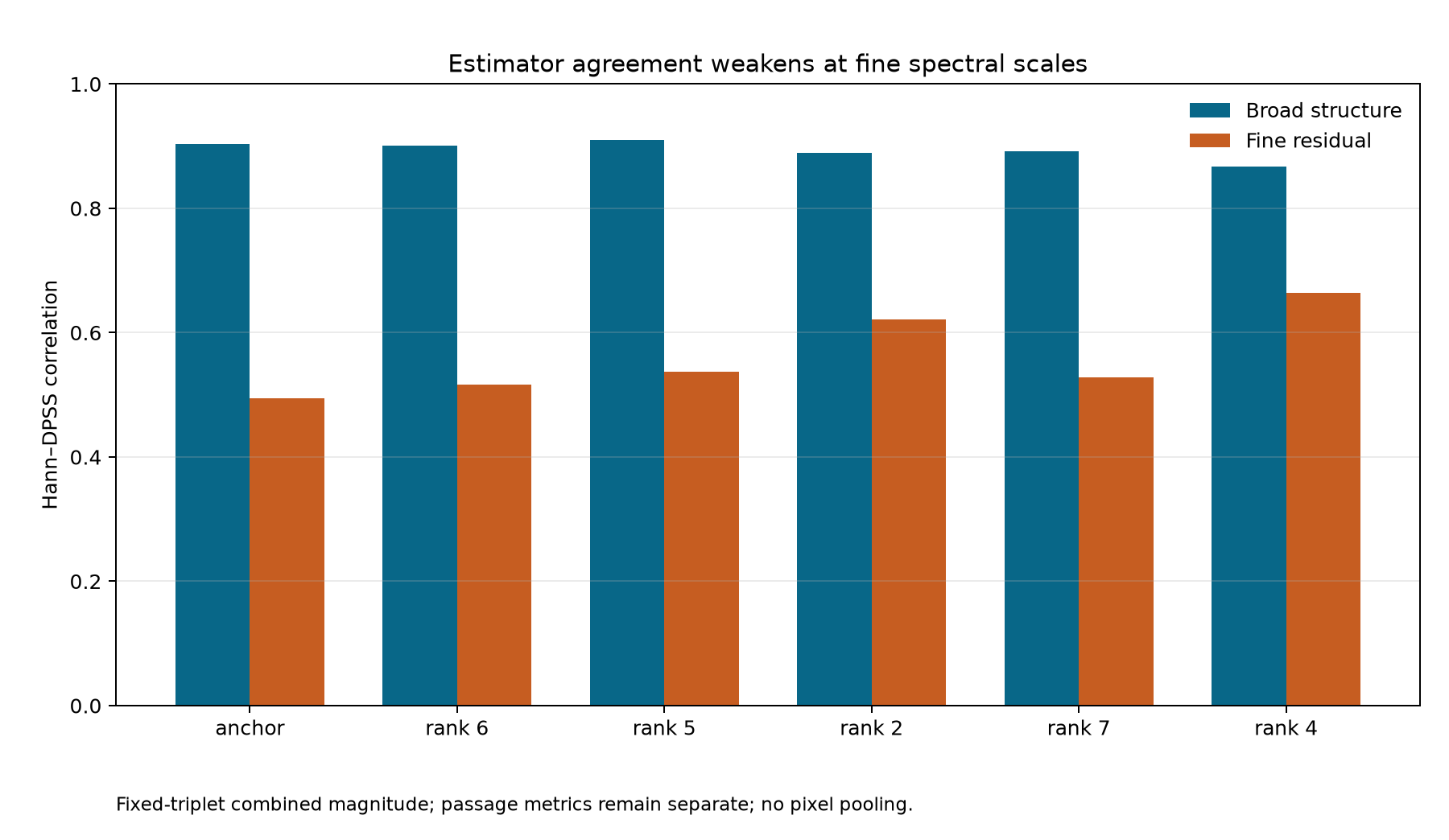
The two spectrogram estimators agree broadly, less so in fine structure

Across six H01W passages and four subjects per passage, the median offset-adjusted correlation is 0.784. After removing broad frequency structure, the median residual correlation is 0.445 and the median absolute residual difference is 3.0 dB.

Boundary: this tests estimator stability on identical waveform support. It does not validate a propagation mechanism or identify a ship.
Summary of Hann and DPSS spectrogram agreement across six H01W passages
Broad agreement remains stronger than fine residual agreement.

Comparison

Matched input coverage

Comparison can only use dates and stations where the relevant AIS, propagation, and waveform inputs coexist.

Waveform coverage

A small mark means one or more bounded waveform intervals start in that month. It never means continuous month-long waveform coverage.

Year
20252026
Month
JanFebMarAprMayJunJulAugSepOctNovDecJanFebMarAprMayJunJulAug
HA01
HA03
HA08
HA10

Comparison across observations

Inspect the measured and modeled distributions before opening one pair.

Compare all 21 ship observations

Show the measured whole soundscape, modeled contribution from one vessel, and measured-minus-modeled residuals at every nominal band. The 21 ship observations use 20 distinct one-hour waveform windows.

Comparison pairs

Keep modeled screening estimates, measured contrasts, and directional checks distinct.

Comparison explorer

Select each higher/lower pair, including the reversed 80 Hz result and the directionally disfavoured case.

Predicted side

The frozen cohort carries screening estimates. They are not accepted RAM one-to-one comparison values.

Observed side

Hydrophone array and hydrophone contrasts are reported separately, with energy and direction kept apart.

Current ceiling

Energy often moved as expected. Direction did not

Boundary: useful bounded acoustic consistency, not ship detection or attribution.
Four paired acoustic comparisons showing energy and directional evidence at 63 and 80 hertz
Energy and directional evidence are kept separate.

Declared work

All active requirements

25 groups at this cutoff.

Traffic and cohort
Available

AMSA 63/80 Hz fast TL screen

88,565 of 150,940 records with predicted RL at both frequencies (58.7%)

The screen uses records with a mapped vessel class, a positive speed no greater than 50 knots, and a positive length. It does not clip or fill missing values.

Source model
Available

Complete AIS source spectra

102,629 spectra; 1,128,919 standard-centre values

All 102,629 AIS records are represented through reusable source-input profiles, with dense 10–100 Hz values for interactive display. RAM is an additional propagation treatment, not an admission rule for the source model.

Predicted RL
Available

All AIS records through fast TL

102,629 records × 96 directly evaluated spectral samples

The explorer shows SL and predicted RL from one vessel at every integer frequency from 5 through 100 Hz for all 102,629 AIS records: 88,565 non-RAM AIS records and 14,064 RAM AIS records. The canonical materialization also preserves 14 standard-centre band values outside the served three-tab browser. The 62,376 excluded raw AIS records remain accounted for by source-input or quality-control reason. Values below 20 Hz are marked as higher-uncertainty source-model extensions.

Receiver-centred propagation
Active

H01W monthly Tier-1 TL sweeps

24 month-frequency runs (12 months × 2 Tier-1 frequencies)

Twelve selected months at 63 and 80 Hz are running on Pazuzu with 88 workers.

Receiver-centred propagation
Active

ARA historical reusable daily TL sweeps

56 runs across two hydrophone arrays, two dates and 14 frequencies

The 31 March Tier-2 campaign is nearly complete on Mefisto after Belfegor finished its partition. The 1 April daily ocean field is available: H10N 63 Hz is running on Pazuzu, while the disjoint H10N 80 Hz and H10S 63/80 Hz partition runs on Belfegor. The remaining 1 April Tier-2 frequencies follow the active Tier-1 work.

Predicted RL
Available

Juan RAM one-to-one RL branches

418 values: 220 at 6 m and 198 at 70% draught

Every row embeds the modeled source level, RAM one-to-one TL, predicted individual RL, units, identities, and evaluation method used by the view.

Predicted RL
Available

Igor RAM one-to-one RL at 6 m and 70% draught

22 values: 11 at 6 m and 11 at 70% draught (6.16 m)

The package combines modeled JOMOPANS source levels with validated RAM one-to-one TL without rerunning propagation. The 70% draught branch uses the admitted repeated same-transit 8.8 m inferred draught and remains distinct from the 6 m branch.

Predicted RL
Waiting

Full modeled-AIS RAM-authority RL products

Membership known; values not yet complete

Every displayed materialized TL field has an explicit downstream standing. 154 TL/RL branches for individual vessels are materialized, including 9 supported by available rays in a sweep field that is still materializing; 9 displayed keys have audited source members that require direct RAM paths, 5 keys end at TL by declaration, and 4 legacy TL-only keys remain outside current source-aware admission. No displayed field is awaiting downstream admission from this refresh.

Response admission
Available

Full-response 10 Hz agreement receipts

16 of 16 active response bindings passed; 2 response members are not applicable because their waveform requests returned authoritative no-data

The rounding-aware comparison admits every active full-response binding without recomputation. It establishes T1 nominal-response standing only, not traceable calibration.

Waveform acquisition
Available

Validated selected holdings

Hydrophone first-product families

The sealed full-active package includes all runnable exact and accepted-gap holdings. No acquisition chunk remains missing or pending; no-data, context-coverage, and response limits remain explicit.

Waveform acquisition
Waiting

Remaining waveform product limits

20 requested hydrophone intervals returned no data; 20 H08N response holds; 1 context-coverage hold

Acquisition has no missing or pending chunks. These remaining scientific and response limits are not silently filled, bridged, or converted into empty products.

Current ARA soundscape
Available

Guarded 5–100 Hz waveform review

Held windows and complete hydrophone-hours

Every usable holding has current guarded products. The 97 blank hours and 1,067 blank band rows remain explicit gap or response-edge evidence; four no-data siblings remain unavailable.

Cross-hydrophone observation
Available

Combined magnitude and spatial consistency

79 magnitude families for hydrophone arrays + 63 full-complex spatial bundles + 16 HA03 magnitude-only bundles

Combined products average aligned hydrophone power in linear units. Full-complex bundles preserve phase-sensitive structure where the response permits it; HA03 keeps only phase-invariant magnitude and matrix-energy quantities.

Directionality
Available

Phase and GCC-PHAT views

63 full-complex bundles; HA03 phase and lag remain unavailable

Phase and GCC-PHAT products are available for H01W, H08S, H10N, and H10S recording intervals whose response supports timing. HA03 has magnitude-only products and cannot fill this role.

Estimator stability
Available

H01W spectrogram method stability

6 passages × 4 subjects; 24 unpooled comparisons

Periodic-Hann and five-taper DPSS estimates use identical samples, masks, windows, and frequency bins. The result measures estimator sensitivity, not source attribution.

Synthesis
Available

Declarative current-state report

Reader page, technical companion, evidence and status indexes

This package closes required report dependencies at one evidence cutoff and may be republished whenever requested or materially useful; identical inputs may remain a no-op.

Annexes

Current views

Juan, Igor, and other explorers

Current bounded-evidence view

Higher/lower comparison pairs

Inspect every pair, including the 80 Hz energy reversal and the directionally disfavoured case. The view distinguishes the frozen cohort's RAM-labelled screening estimates, their limited standing, a separate fast TL screen for the same AIS record, and the measured hydrophone array and hydrophone contrasts.

Current validated comparison

H01W spectrogram method stability

Compare periodic-Hann and five-taper DPSS estimates across six passages and four subjects on identical usable waveform support.

Current registered view

Full-active waveform product browser

Browse the sealed 217 hydrophone and 79 hydrophone array first-product families while preserving waiting, no-data, gap, and response-limited states.

Current registered view

Hydrophone array spatial consistency

Inspect all 63 full-complex spatial bundles and all 16 HA03 magnitude-only bundles. Coherence and matrix energy do not establish ship attribution.

Current registered view

AIS acoustic explorer

Choose any named AIS set and inspect source spectra, fast TL, or predicted received level for all 102,629 AIS records across the full 5–100 Hz source grid.

Current registered view

Predicted RL with fast TL

Browse SL, the record's range-only fast TL screening value, and predicted RL from one vessel for all 102,629 AIS records at 1 Hz spacing from 5 through 100 Hz.

Current observed-soundscape view

Current ARA guarded 5–100 Hz review

Inspect 32 hydrophone windows, complete and blank hours, band summaries, 9,192 hydrophone tone candidates, and 1,907 multi-hydrophone tone families. This view does not claim ship detection or attribution.

Current public collaborator view

Measured-versus-modeled spectral comparison requested by Igor

For the complete Highlighted 21, inspect spectral SL with source-model scatter, direct-path RAM TL, predicted individual-vessel RL, and the measured whole-soundscape SPL. The measured curve is context: it is not a detection, attribution, or propagation validation.

Current registered view

Highlighted TL context inspector

Inspect all 294 RAM one-to-one TL rows across the 21 highlighted paths, together with fast TL context, source-depth availability, and evidence identities.

Current collaborator view

26 March dense-track direct-TL report

A reader and technical package for the sealed 720-case, 63/80 Hz fixed-versus-geology-informed replay at the H01W1, H01W2, and H01W3 hydrophones.
Historical reports

Frozen snapshots and sensitivities

Historical sensitivity evidence

Seabed-treatment sensitivity

Compares completed fixed-bottom and geology-informed RAM results without treating either as the physical truth.

Historical interactive evidence

Full-population sediment/TL explorer

The Juan AIS comparison and H10 cases; four source-ineligible Juan raw records remain only as TL-only provenance, and current desired RAM uses geology-informed bottoms.

Other analyses

Side work and null results

Dense-track direct TL

A sealed 720-case, 63/80 Hz direct-path replay across the H01W1, H01W2, and H01W3 hydrophones.